
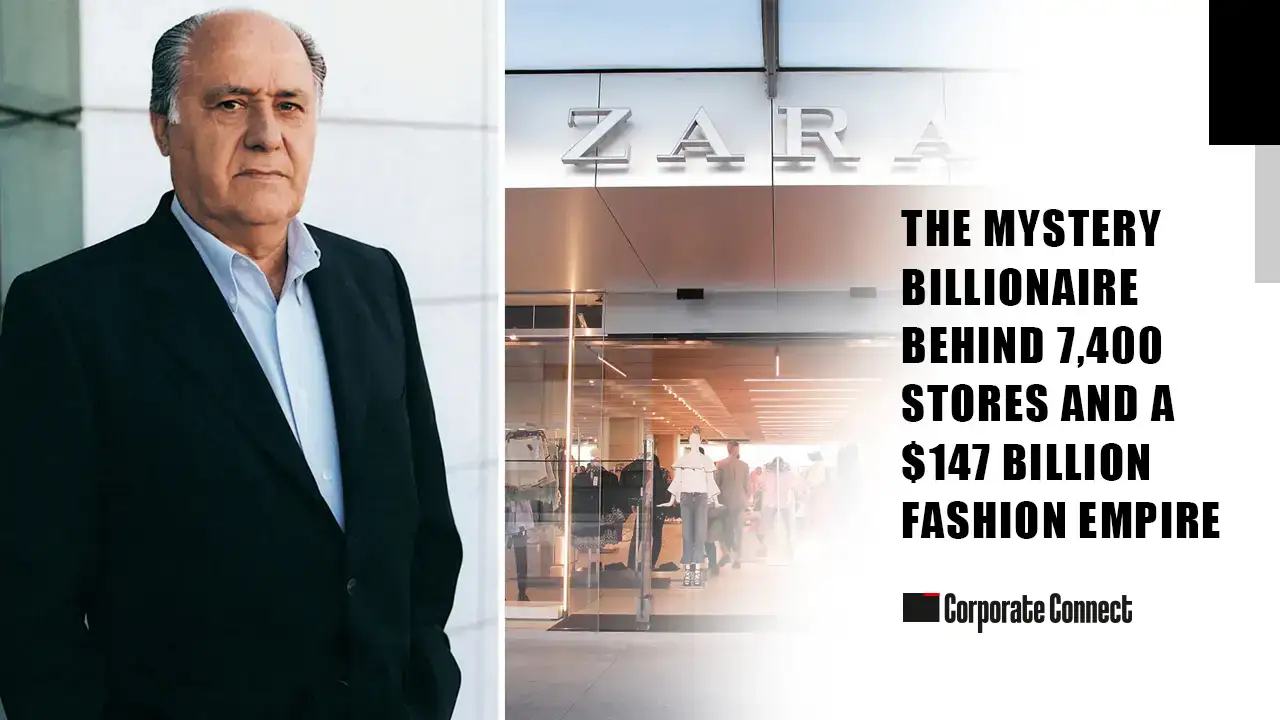
Amancio Ortega never attended college. He was not a wealthy heir. At the age of 13, he began folding shirts in a little business in La Coruña, Spain, a place most people had never heard of. However, Amancio Ortega would go on to turn Inditex and the Zara empire into the world’s biggest fast fashion conglomerate, eventually surpassing Bill Gates as the richest person in the world.
That story is one of the most significant business storylines of the past century; it is unvarnished, meticulous, and accomplished almost imperceptibly. Furthermore, the majority of people are still unaware of his name.
The holding company Ortega established in 1985, Inditex, now brings in an estimated $31 billion a year. 59% of it is individually owned by Ortega. His $17.2 billion real estate holdings through Pontegadea include energy interests in Spain, skyscrapers in Miami, and Amazon’s Seattle offices. The man who started off stitching bathrobes with his siblings is now in charge of an empire spanning 77 nations.
Amancio Ortega and the establishment of Zara: An untried model
Prior to Zara, everything was determined by the fashion calendar. Months ahead of time, designers would produce collections. Inventory would be sent to stores twice a year. Clients would hold off. Trends would either completely miss them or arrive late. Amancio Ortega made the decision to completely end that cycle by using brutal operational efficiency rather than disruption drama.
In just two weeks, Ortega’s manufacturing and design loop could take a runway style and deliver it to store shelves. Rivals had deadlines of at least six months. Zara was intended to bridge that gap between what was available and what was fashionable.
How did Amancio Ortega become the richest person in the world?
Amancio Ortega was at the top of the world wealth rankings in 2015 when his net worth momentarily overtook that of Bill Gates. It was a logical and unexpected time. For decades, Inditex has been quietly growing, entering Portugal, France, the US, and eventually 77 other countries. Massimo Dutti, Pull&Bear, Bershka, and more brands were added by Inditex beneath the Zara name, expanding its reach without weakening its basic concept.
In one of the biggest IPOs in Spanish history, Inditex raised $2.7 billion when it went public in 2001. What insiders already knew—that this was not your average retailer—was instantly apparent to the market. It was a data-driven, vertically integrated machine with structural benefits that were nearly impossible to duplicate.
What can business owners take away from the Amancio Ortega business model?
The majority of people learn speed from Amancio Ortega. Get goods onto the market more quickly. Respond swiftly to trends. That is accurate, but it ignores the more fundamental idea. The true accomplishment of Ortega was creating a system that became more intelligent over time.
Information was transmitted back into the system with each store visit, sale, and item placed on a rack. Zara did more than just sell clothing.
Ortega was also aware of the cruelty-free psychology of scarcity. Customers were not turned off by Zara’s limited stock of each style, which created a sense of urgency. If you spotted something you liked, you bought it because it might not be available the following week.
Department shops could never equal the regularity of foot traffic and repeat business generated by that purposefully created conflict. An average Zara consumer makes 17 visits annually. The average for the industry is more like three.
In many respects, the fashion business was a closed discussion prior to Zara. Luxury brands catered to affluent consumers. Affordability was provided by mass sellers, but aspiration was lacking. Amancio Ortega created a bridge to bridge the distance between those two universes. Zara made apparel from the runway affordable for people with average earnings without making it seem cheap.
The industry as a whole was affected. Every fast fashion company that came after, including H&M, Topshop, and Forever 21, owes at least some of its business strategy to Ortega’s model. His detractors would point out that excessive consumption, textile waste, and labor issues were all caused by fast fashion.
There is more to the Zara business than just apparel. It’s a lesson in how profound operational thought, patience, and systems can come together to create something that would never be possible with a single brilliant move. Fashion was not disrupted by Amancio Ortega. One hastily stitched garment at a time, he rewired it from the inside out.