

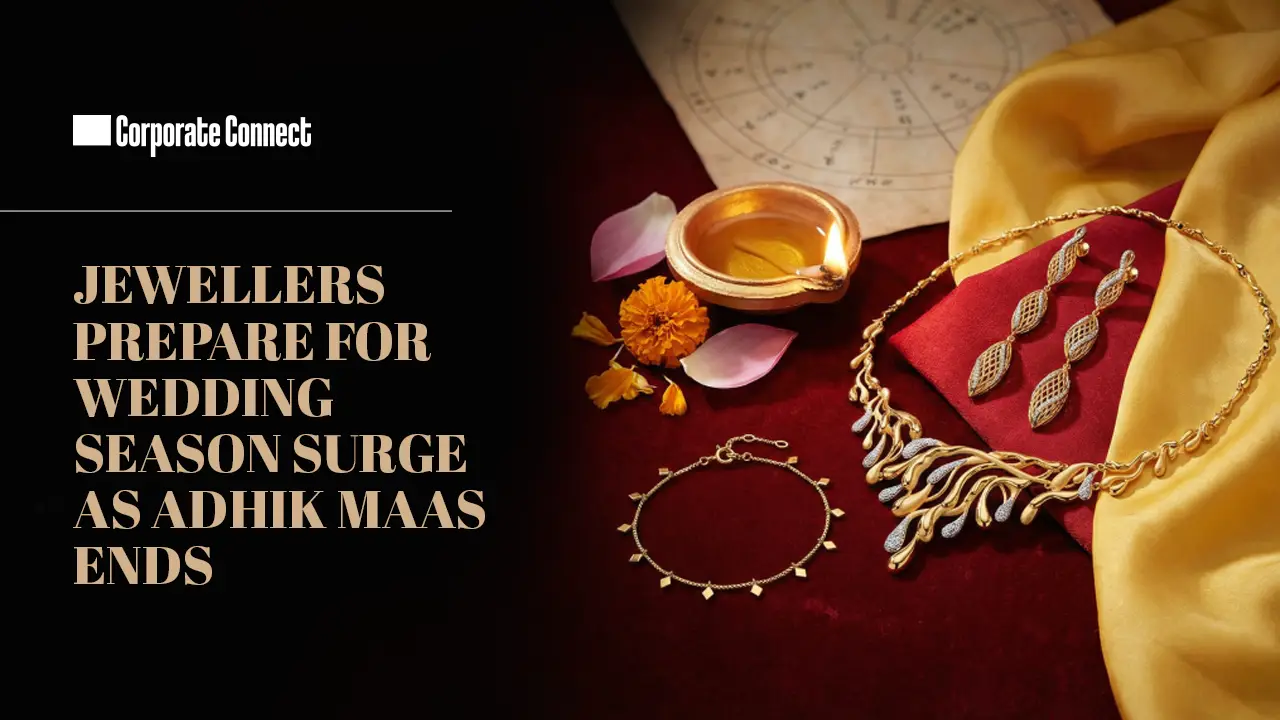
Jewelers are wagering on a rebound in demand as Adhik Maas comes to a close and the wedding season resumes, albeit one that is more influenced by caution, rising gold costs, and shifting consumer behavior. Customers are recalibrating expenditure through lightweight jewelry, defined budgets, and old-gold exchange schemes, even if wedding-related purchases are still mostly non-deferrable.
According to industry insiders, consumers are increasingly basing their purchases on fixed rupee budgets rather than on fluctuating gold prices. Many of them temporarily postpone purchases during price surges before resuming their scheduled wedding expenditures. Multiple wearable pieces are becoming more popular than a single heavy item, according to several brands. According to Augmont, old-gold exchange currently finances between 40 and 70 percent of transactions, making it a crucial affordability lever.
The government’s May tariff increase on gold imports from 6% to 15%, which significantly increased acquisition prices, coincided with the Adhik Maas period, which is typically connected with a break in weddings and large-ticket purchases, causing demand to temporarily slow down over the previous month.
“We anticipate a strong season. We’ve discovered that clients actually arrive with a budget rather than searching for less expensive jewelry. Gaurav Singh Kushwaha, CEO and founder of BlueStone, told BW Businessworld, “The budget holds, the gold price is secondary. Even when gold prices rise, someone who was going to buy a piece worth Rs 60,000 still wants a Rs 60,000 piece.”
As the wedding calendar reopens, demand will rise again.
According to industry insiders, the recent decline in gold prices—down over 15% from January highs—has begun to rekindle inquiries and purchasing intent, especially for wedding-related purchases that had been postponed during Adhik Maas. Although customers were initially hesitant due to macro uncertainties and high prices, the reopening of the auspicious wedding calendar is anticipated to release pent-up demand.
“After June 15, we anticipate a significant demand release. According to Renisha Chainani, Head of Research at Augmont, “Adhik Maas typically pauses weddings and gold purchases, and this year it coincided with the May 13 duty hike, a double suppression.” According to Chainani, the hike in import duty from 6% to 15% increased landing expenses by approximately Rs 9,000 to 10,000 per 10 grams, which caused customers to become more frugal and halt discretionary purchases.
But instead of making cuts, this caution is translating into recalibration. According to Kushwaha of BlueStone, consumers are sticking to set budgets rather than shifting gold prices, thus they keep buying despite price increases. He stated, “It is our responsibility to produce goods at those price points.”
Jewelers in the sector claim that the strategy is changing from selling grams to selling designs. As consumers seek affordability without sacrificing desire, lightweight, modern jewelry, studded items, and old-gold exchange programs are gaining popularity. Augmont estimates that between 40 and 70 percent of transactions are now funded by old-gold exchange, while Shyam Jewellers saw a growing preference for “three to four versatile pieces” over a single heavy item.
Keeping Aspirations and Budget in Check
One of the most obvious changes this season, according to industry insiders, is the trend toward wearable, lightweight, and design-driven jewelry as buyers try to strike a compromise between their desire for a wedding and the rising cost of gold.
Customers have been a little wary due to the continuous unpredictability around gold prices. But during festivals and the wedding season, buying gold has always been a top priority, according to Shyam K Satikuvar, co-founder and partner of Shyam Jewellers.
He mentioned that because old-gold exchange lowers the total cost of buying, the company is seeing an increase in interest in it. He said, “Some customers are also choosing lighter-weight jewelry or making purchases in phases/parts similar to SIP instead of buying everything at once.”
According to BlueStone, jewelers are recalibrating inventory toward lightweight and modern collections, while consumers are still dedicated to spending but demand brands to produce goods within set budgets. Augmont claims that in order to mitigate the effects of gold price fluctuation, the industry is increasingly depending on hollow, laser-cut, and lighter forms that maintain aesthetics while lowering the amount of gold by 30 to 40 percent, combined with a higher mix of studded jewelry.
Affordability-driven purchasing strategies are also gaining traction. As consumers seek to recycle previous holdings to finance new purchases, Shyam Jewellers noted the growing popularity of old-gold exchange schemes, a trend that is reflected throughout the sector.
Growth in Lab-Grown Diamonds
Customers are increasingly looking for options that maximize style and visual appeal without drastically straining budgets, according to some jewelers. Industry participants in the lab-grown diamond (LGD) market have observed that although customers’ intentions to spend money on weddings are still the same, buyers—especially younger ones—are becoming more frugal with their spending, giving size, style, and adaptability precedence over conventional metal-heavy purchases.
“A change in behavior is being driven by the end of Adhik Maas and the approaching wedding season. Ricky Vasandani, CEO and co-founder of Solitario, stated, “We are not seeing a drop in intent; instead, we are seeing a pivot, even though soaring gold prices have made traditional buyers cautious.”
He pointed out that buyers are increasingly choosing lab-grown diamonds to acquire larger statement pieces without significantly raising cost, as opposed to delaying purchases or sacrificing on wedding jewelry.
Stronger wedding inquiries and pre-bookings are expected to fuel Solitario’s 35–40% year-over-year increase in the forthcoming season. Similar trends are occurring at DiAi Designs, where founder Disha Shah reported that instead of being overtly cautious, customers are becoming more deliberate.
“The buyer who has a wedding to plan or a milestone to mark is still committed, just spending with more intention than before,” Shah stated, pointing out that as customers seek to recycle existing gold into more wearable pieces, demand for remakes and redesigns utilizing vintage jewelry has also increased. Beyond local retail demand, the impact of high prices is also evident in exports, which indicate supply limitations and a decline in demand elsewhere.
Pressures from Exports
Beyond local retail demand, the impact of high prices is also evident in exports, which indicate supply limitations and a decline in demand elsewhere. With the reopening of the wedding calendar, domestic demand prospects have improved, but supply-side challenges still plague the larger gems and jewelry business. The total gross exports of gems and jewelry were USD 4,274.34 million, according to the Gem and Jewellery Export Promotion Council (GJEPC). This is a 6.03% year-over-year decrease from April to May 2026.
At USD 3,251.79 million, the total gross imports of jewelry and diamonds represented a 12.67% year-over-year decrease. During the same time period, the provisional gross export of all gold jewelry likewise decreased by 18.59%. However, between April and May of 2026, the provisional gross export of silver jewelry increased by 172.53%. During the same time period, the gross imports of cut and polished diamonds increased by 101% to USD 294.25 million.
For jewelers, the next wedding season may ultimately test how customers choose to spend money rather than whether they are willing to spend it. As the wedding calendar reopens, industry leaders anticipate a resurgence of demand, but one that is increasingly influenced by lighter formats, design-led purchases, and more prudent budget allocation.