

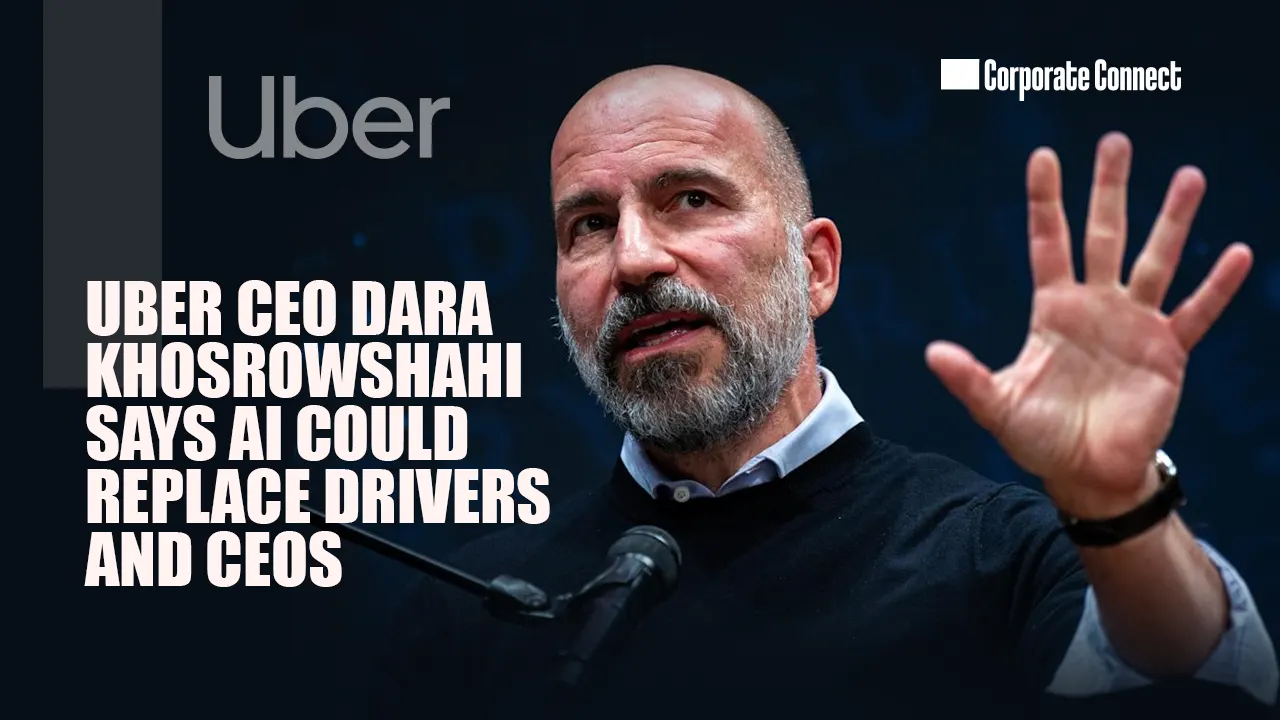
Dara Khosrowshahi, the CEO of Uber, has discussed the increasing importance of artificial intelligence in the company. He indicated that AI might one day assume driving jobs and even leadership positions, including his own. Khosrowshahi detailed on The Verge’s Decoder podcast Uber’s experiments with AI in various aspects of its operations, including coding and customer support, as well as more ambitious initiatives like self-driving cars.
His remarks, however, bring attention to a more subtle stance: he thinks that while jobs will be transformed by AI, the future is in humans collaborating with AI systems instead of being entirely supplanted by them.

Khosrowshahi’s comments regarding AI taking over roles
Khosrowshahi recognized in the talk that AI is progressing at a sufficient pace to assume more and more intricate duties. He pointed out that there is already an internal “AI version” of him at Uber, developed by staff to simulate presentations and decision-making situations.
He mentioned that although AI could theoretically take on various roles, including that of a CEO, the preferable scenario involves a blend of human judgment and machine intelligence. He remarked, “The AI-powered CEO will surpass the AI CEO,” suggesting that teamwork is expected to excel beyond complete automation.
The impact of AI on Uber’s operations already
Uber has begun to incorporate AI across various aspects of its operations. The company employs AI tools to support engineers in coding and product development and is also testing AI-driven customer service systems that can interpret outcomes rather than adhere to strict policies.
Khosrowshahi also emphasized the transformation of internal decision-making and productivity by AI. The firm is making significant investments in AI infrastructure and is even modifying its hiring strategy to align with the rising expenditures on AI tools and computing resources.
The implications for drivers and autonomy
This dialogue is also connected to Uber’s wider initiative aimed at self-driving cars. Khosrowshahi did not provide a specific timeline for driver replacement, but he recognized that the future of robotaxis is an important area of focus.
He proposed simultaneously that the intricacies of real life — including traffic situations, last-minute cancellations, and the element of surprise — provide Uber with an edge compared to AI systems that rely solely on software.
The future of AI at Uber: replacement or partnership
Khosrowshahi’s comments mirror a wider change in the industry, viewing AI as both a disruptor and an enabler. Although automation might take over some jobs eventually, it seems that Uber’s present strategy is aimed at enhancing human abilities instead of completely removing them.
He maintains a clear focus on his main argument: while AI alone may not suffice, its integration with human decision-making could transform the operations of companies like Uber in the coming years.
FAQs – Uber CEO on AI, Jobs & Future of Work
1. What did Uber CEO Dara Khosrowshahi say about AI and jobs?
He said that AI could eventually take over driving jobs and even leadership roles, but the future will likely involve humans working with AI instead of being fully replaced.
2. Can AI really replace a CEO like Dara Khosrowshahi?
Khosrowshahi suggested that while AI could technically perform CEO-like tasks, the best outcome would be a combination of human judgment and AI intelligence, not full replacement.
3. How is Uber using AI today?
Uber is already using AI for coding assistance, product development, customer support, and operational decision-making.
4. Is Uber working on self-driving cars?
Yes, Uber is actively investing in self-driving and robotaxi technology, which could reduce dependence on human drivers in the future.
5. Will Uber drivers be replaced by AI soon?
There is no fixed timeline. While autonomous vehicles are being tested, real-world challenges like traffic and unpredictable conditions still require human involvement.
6. What is the concept of an “AI-powered CEO”?
It refers to using AI systems to simulate leadership decisions and strategies. However, Khosrowshahi believes a human-AI combination would perform better than AI alone.
7. How is AI changing Uber’s internal operations?
AI is being used to improve efficiency in engineering, coding, customer support, and decision-making processes within the company.
8. What is Uber’s future strategy with AI?
Uber aims to use AI as an enhancement tool rather than a full replacement, improving productivity and human decision-making.
9. Did Uber CEO confirm job losses due to AI?
No, he did not confirm mass job losses. Instead, he emphasized job transformation rather than full replacement.
10. What is the biggest advantage Uber has over AI systems?
According to Khosrowshahi, Uber benefits from real-world complexity like traffic, human behavior, and unpredictable situations, which AI alone cannot fully handle.