
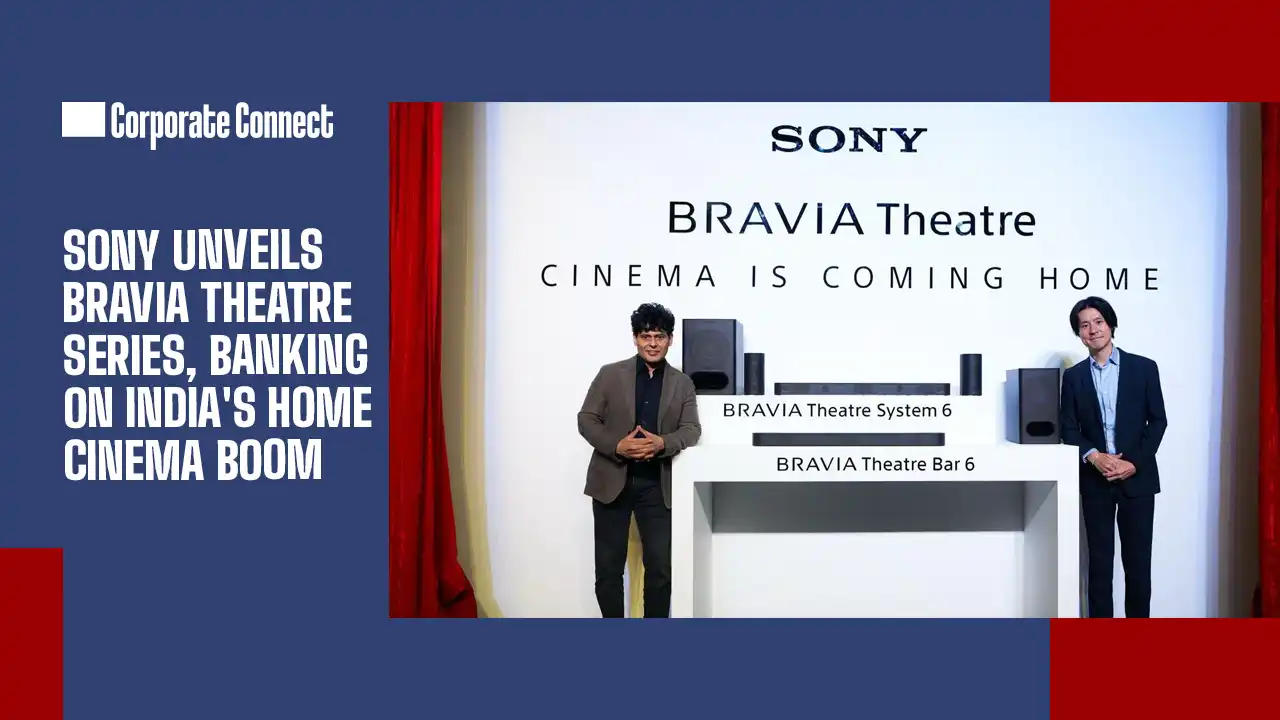
Sony is betting on a growing shift among Indian consumers from buying standalone televisions to building complete home entertainment systems, as the company on Wednesday expanded its premium BRAVIA Theatre portfolio with a new range of soundbars, subwoofers and wireless rear speakers.
In an effort to meet the growing demand for movie-like experiences at home, the business introduced the flagship BRAVIA Theatre Trio wireless home theatre system in addition to the BRAVIA Theatre Bar 7, Theatre Bar 5, Theatre Sub 9, Theatre Sub 8, Theatre Rear 9, and Theatre Rear 8.
The introduction coincides with a more general change in consumer behavior that is changing the home entertainment sector in India.Nezu Daisuke, Global Head of Sony Electronics Corporation’s Home Audio and Video Division, told ET Online, “We are seeing a clear shift from value-driven purchasing to experience-driven decision-making.”
Daisuke claims that people are no longer judging televisions only on their features or cost. Rather, the quality of the entire entertainment experience—which includes immersion, sound quality, and picture quality—is increasingly influencing consumer choices.
According to industry data, the change in purchasing habits is already apparent. India’s smart TV shipments stayed relatively stable in 2025, according to Counterpoint Research, but larger screen sizes continued to gain market share, with 55-inch and larger televisions emerging as the main growth driver. As consumers switched to better-equipped televisions, premium price bands between Rs 40,000 and Rs 50,000 also did better than the overall market.
As people look for movie-like experiences at home, the trend is spreading beyond screens into audio products. According to research firm IMARC Group, the home theatre market in India was estimated to be worth $544.6 million in 2025 and is projected to expand at a compound annual growth rate (CAGR) of 17.45% through 2034 due to the increasing use of high-end audio systems, Dolby Atmos-enabled devices, and an increase in OTT consumption.
Additionally, the soundbar market is growing quickly. The market for soundbars in India was estimated to be worth $203.2 million in 2025 and is projected to more than double to $450.5 million by 2034 as more people purchase specialized audio systems to go with larger screens.
The goal of Sony’s most recent lineup is to take advantage of that chance.
The BRAVIA Theatre Trio, Sony’s flagship wireless home theater system made for ultra-large-screen televisions, is the focal point of the introduction. In contrast to conventional soundbars, the system is touted to accommodate Dolby Atmos and DTS audio codecs and use discrete left, center, and right speakers. According to Sony, it can produce up to 24 virtual “phantom” speakers that mimic a movie theater’s surround sound system when combined with appropriate subwoofers and rear speakers.
Along with two wireless subwoofers and rear speaker systems that enable customers to progressively extend their home entertainment setup, the company also unveiled the BRAVIA Theatre Bar 7 and Theatre Bar 5 soundbars, which support Dolby Atmos and Sony’s exclusive spatial audio capabilities.
Additionally, Sony is launching a feature dubbed BRAVIA Direct Connect, which enables users to gradually construct home theater systems by connecting compatible BRAVIA televisions directly to rear speakers and subwoofers without the need for a soundbar.
What Sony perceives as a distinctively Indian consumption trend is reflected in the strategy.
In India, entertainment is still a shared experience with friends and family, in contrast to many developed nations where content consumption is frequently a solitary activity. According to Daisuke, this raises the need for bigger screens, strong sound systems, and group-enjoyable immersive viewing experiences.
Because of its distinctive viewing habits, Sony thinks India is especially well-positioned for this change.Instead of viewing their entertainment setup as a solitary television purchase, consumers are increasingly considering it as a whole ecosystem, according to Daisuke.
The business anticipates a further narrowing of the gap between home entertainment and movies in the future.
“India will play a significant role not only in driving business growth but also in shaping future innovation,” Daisuke stated, noting that the nation’s size, diversity, and quickly changing customer tastes provide insightful information for upcoming product development.
Sony anticipates that as advancements in display technology, audio systems, and content transmission enhance the quality of in-home watching, the gap between traditional cinema and home entertainment will become even smaller.
“I believe the distinction between cinema and home entertainment will become increasingly blurred,” Daisuke stated. He continued by saying that houses might become the main location for top-notch entertainment experiences as premium content experiences are increasingly created with home viewing in mind from the beginning.
The Theatre Bar 7 and Theatre Bar 5 cost Rs 1 lakh and Rs 38,000, respectively, while the BRAVIA Theatre Trio costs Rs 2.4 lakh.