

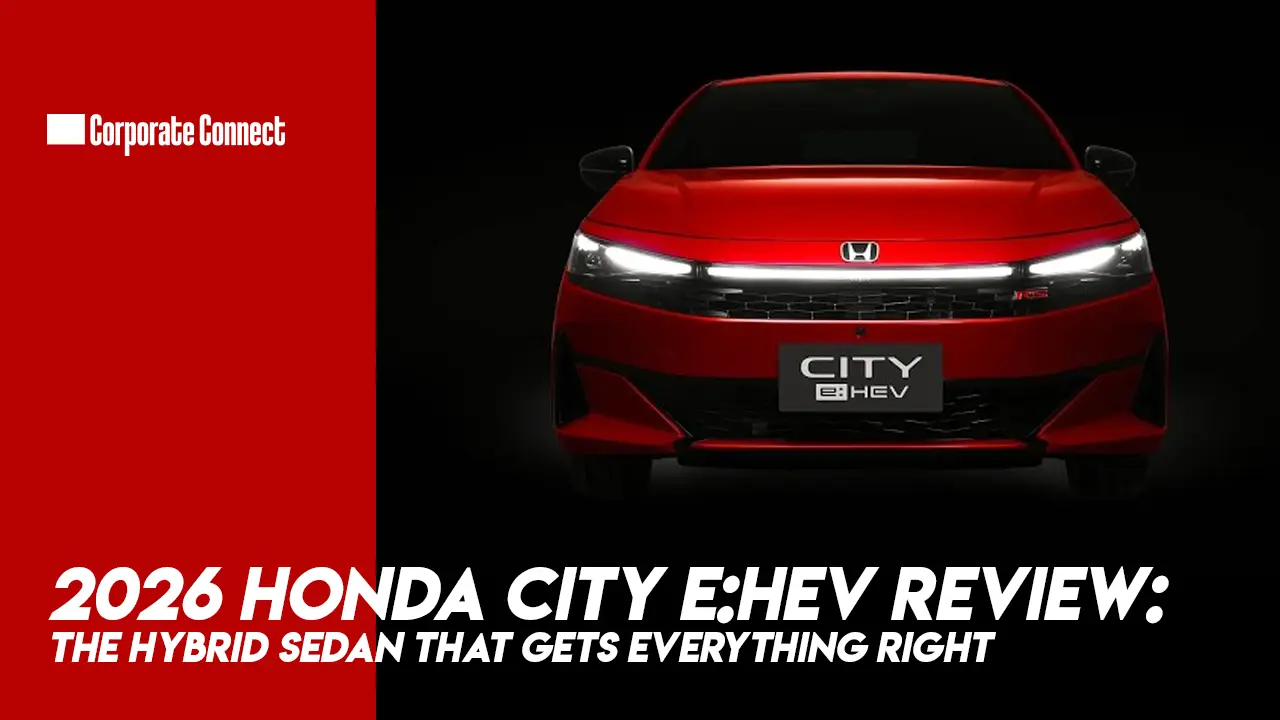
The Honda City’s reputation has grown over the years, something that very few automobiles in India have experienced. The City has continued to be one of the most sought-after sedans in the nation for nearly thirty years, spanning five generations. Despite SUVs taking center stage, it has endured shifting trends, welcomed new competitors, and remained relevant.
The 2026 facelift is noteworthy because it marks the beginning of Honda’s reinvigorated product offensive in India, not because the company has completely reimagined the City. Honda has improved the appearance and incorporated a number of amenities to appeal to younger consumers, even if the name is still recognizable.
I drove the top-spec Honda City e:HEV ZX+ model from 2026 for a few hours. It is still the only powerful hybrid sedan in its class. Here are my initial impressions from the drive.
Images Don’t Do It Fairly
The way the new city seems in person is one thing that sticks out right away. Simply put, pictures don’t do the automobile credit. The sedan now has a considerably sportier appearance thanks to the revised front end. The blacked-out grille, redesigned bumper treatment, slimmer Blade Eye Signature LED headlights, and integrated lighting element give the City a more modern appearance without going excessive.
Additionally, a brand-new Crystal Black Pearl color has been added to the City for the first time. This color is undoubtedly the finest fit for the sedan, giving it a subtle yet aggressive look.
The 2026 City’s length of 4,594 mm, 11 mm longer than its predecessor, makes it the longest sedan in its class, increasing its road presence. Many sedan fans would find the City’s distinctive three-box appeal appealing due to its exquisite proportions.
Although Honda’s new 16-inch dual-tone alloy wheels are beautiful, the competitors’ larger wheels undoubtedly offer more visual drama.
Changes are slight toward the back. The updated bumper and spoiler provide some sportiness, but the recognizable taillamps are still there. All things considered, the City nonetheless maintains its graceful proportions and draws a lot of traffic.
The cabin feels revitalized.
The city feels familiar as soon as you step inside. That’s not always a negative thing. Overall, the design is clear, useful, and simple to comprehend. The cabin’s new color scheme of ivory and black gives it a luxury vibe, and the build quality feels strong. Despite the asking price, you are reminded that this is not a high-end sedan by the abundance of harsh plastics around the dashboard and lower areas.
Honda should be commended for not pursuing gimmicks. Honda has kept physical buttons and rotary dials for climate settings at a time when many manufacturers are switching nearly everything to touchscreens. These haptic controls are enjoyable to use and greatly simplify daily tasks.
Additionally, the wide-opening doors make entry and exit simple, and Honda’s switchgear quality never ceases to amaze.
The ventilated front seats are particularly noteworthy among the new features. They are actually helpful in Indian weather conditions and operate incredibly well. The City’s ventilated seats work well and instantly improve interior comfort, in contrast to other competitors that just provide a slight cooling effect. It is a feature that consumers will value on a daily basis.
Technology Examination
The new 10.1-inch infotainment screen is one of the most talked-about features in the cabin. On paper, the larger display is a great upgrade, but there is space for improvement in its implementation. The screen appears to be an afterthought rather than something that was included into the dashboard from the start, with its odd upward tilt. Reflections and glare become a big problem in direct sunshine, and sight is significantly reduced.
In a similar vein, 360-degree cameras were long overdue and are now almost expected in high-end vehicles. Although the function is a huge benefit in and of itself, the image quality is far from ideal. Although the video feed seems mediocre and the resolution should have been higher, the feature is helpful in confined parking situations.
Honda Sensing Level 2 ADAS, wireless Android Auto and Apple CarPlay, an eight-speaker sound system, a part-analogue, part-digital 7-inch instrument cluster, a sunroof, ambient lighting, an air purifier, dedicated rear AC vents, two Type-C ports at the back, and a wireless charger conveniently positioned between the electronic parking brake and the center armrest are all still available, and the overall tech experience is still user-friendly.
Rear Seat Royalty
The Honda City’s strength has always been its space, and this is still the case with the 2026 redesign. For two people, the rear seat is really comfortable. Long trips are comfortable since there is plenty of legroom and a general feeling of space.
Additionally, Honda’s well-considered rear sun blind enhances passenger comfort and elevates the cabin. It is comfortable enough for two adults to spend hours in the back without complaining. But rather than being a real five-seater, the City functions best as a four-seater. The middle passenger is not as comfortable as those seated on either side since the center part of the rear seat is somewhat raised.
Strong Hybrid Remains the Main Attraction
Honda’s 1.5-liter Atkinson-cycle gasoline engine and two electric motors power the City e:HEV (hybrid). Combined output stands at 126 PS power and 253 Nm peak torque, while power is sent to the front wheels through an e-CVT gearbox.
Depending on the driving circumstances, the system automatically converts between EV, Hybrid, and Engine modes. Despite the short first drive, one thing was clear right away: the hybrid configuration is still one of the City’s greatest advantages. It has a smooth, elegant texture and is ideal for daily usage.
With an ARAI-certified fuel efficiency rating of 27.26 km/l, Honda’s sedan is among the most fuel-efficient models available today. However, we were unable to independently confirm these figures because of the short driving time.
Triple-Digit Cruiser
The City Hybrid feels calm and self-assured when driving on the freeway. The car never seems strained or out of breath, even at speeds over 100 km/h. The vehicle maintains speed nicely and overtakes are simple.
The engine tone, however, is what becomes apparent. The engine becomes noticeably louder within the cabin once speeds reach triple digits. Crucially, this isn’t because the vehicle is having trouble. The performance is still excellent, and the City keeps picking up speed without pausing. The more prominent soundtrack at faster speeds—or, perhaps more accurately, the music to the ears—may actually be appreciated by enthusiasts.
Despite the roughly 20 kg increase in kerb weight, Honda has once again achieved a remarkable balance between handling and comfort.
It’s interesting to note that the paddle shifters behind the steering wheel are designed to modify regenerative braking levels rather than shift gears.
The hybrid powertrain provides smooth and stress-free movement in urban traffic. The City simply conducts business in a composed and elegant manner, which has always been one of Honda’s biggest advantages.
Where Honda City Still Excels
The City is instantly recognizable when driving, and visibility is still very good. Traffic in cities is easy to navigate. The car is easy to maneuver in traffic because to its low bonnet and well-proportioned dimensions, and the low-slung seating position serves as a reminder of why many fans still favor sedans.
Passengers are kept comfortable by the suspension’s mature absorption of bumpy roads. Road bumps are handled with assurance, and the vehicle maintains composure while moving quickly. The steering is still lightweight and simple to operate.
Overall, the city prioritizes comfort over outright sportiness in performance, and that suits its character perfectly.
What The 2026 Honda City Still Misses
- Electrically adjustable front seats
- Folding rear seats in the e:HEV
- Bigger boot space in the hybrid variant
- A turbo-petrol option for enthusiasts
Conclusion: Still Among the Best Sedans
Honda hasn’t attempted to change the City into something it isn’t, which is what makes this 2026 facelift unique. The Japanese automaker has remained loyal to the principles that are most important, such as comfort, elegance, pragmatism, and efficiency, rather than pursuing enormous screens, touch-heavy controls, and other gimmicks. It still knows precisely what it wants to be after all these years, and it does it incredibly well.
Indeed, there is room for development in the 360-degree camera quality, the infotainment screen should have been better integrated, and it is difficult to overlook the lack of a powered driver’s seat. However, these flaws are insufficient to overshadow the City’s fundamental advantages.
The top-spec ZX+ e model tested here costs Rs 21 lakh (ex-showroom), so the City Hybrid is definitely not cheap. In actuality, the premium price places it firmly in the realm of larger SUVs with greater features. The City, however, has always had a different approach.
The 2026 Honda City Hybrid is worth serious consideration for buyers who value comfort, refinement, and fuel efficiency, spend most of their time in the city, occasionally take long highway excursions, and still find sedans to be charming.
The Honda City continues to remind us that there is still something beautifully sedanly about sitting low, extending out, and just enjoying the drive in a market that is fixated on SUVs.
City Lights
- Excellent ride & handling
- Images don’t do justice to the car
- Physical buttons & rotary dials
- Superb all-round visibility
- Ride quality is among the best in the segment
- Comfortable rear seat for two occupants
- A new Black body colour option
City Limits
- Tilted infotainment screen
- Average 360-degree camera quality