
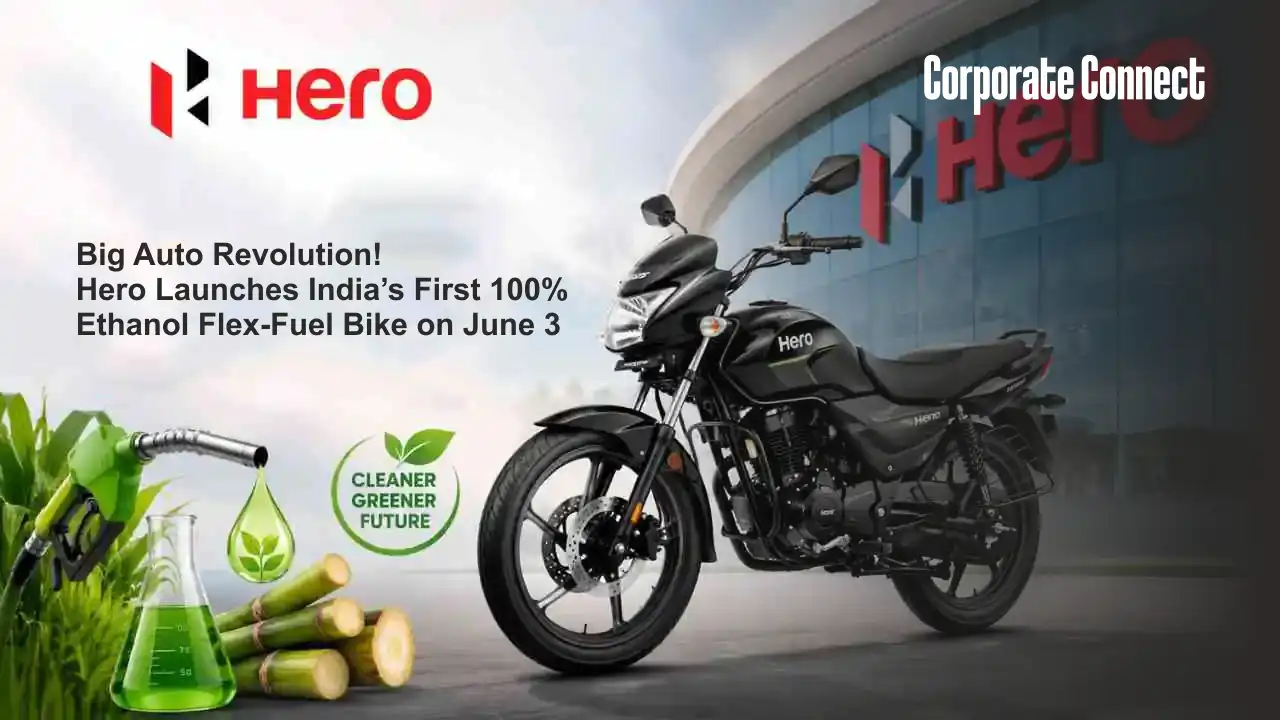
New Delhi, June 2, 2026 — Hero MotoCorp is preparing to debut the nation’s first motorcycle that can operate entirely on ethanol on June 3, 2026, marking a significant milestone for India’s green mobility movement.
Hero MotoCorp, the largest two-wheeler manufacturer in India by volume, will introduce its first flex-fuel motorcycle that can run entirely on ethanol, making it the nation’s first of its kind.
Which Bikes Are Expected?
The HF Deluxe Flex Fuel and the Splendor Plus Ethanol, which are both compatible with E85 and E100 fuel blends, are anticipated to be the next releases. These motorcycles are popular in both urban and rural areas and are among Hero’s best-selling items.
A Step Beyond the Competition
The Suzuki Gixxer SF 250 and Honda CB 300F are the only flex-fuel motorcycles currently offered in India that run solely on E85. By supporting E100, or pure ethanol, Hero’s next bikes will go one step farther.
Expected Pricing
The flex-fuel models are expected to cost around ₹5,000 more than current E20-compliant versions. The Hero HF Deluxe Flex Fuel could be priced at approximately ₹77,000, while the Splendor Plus Ethanol may come in at around ₹88,000 (both ex-showroom).
The Bigger Picture: India’s Green Fuel Push
India’s E100 vehicle launches come in a cluster—Hero MotoCorp’s motorcycle on June 3, followed by Maruti Suzuki’s E100-capable passenger car on June 5 (World Environment Day). These landmark launches mark India’s decisive shift toward 100% ethanol mobility.
A powerful revolution in clean fuel is about to begin in both the two-wheeler segment and the passenger car market. Unlike EVs, flex-fuel vehicles leverage existing liquid-fuel distribution infrastructure while cutting tailpipe emissions significantly
Other OEMs are also racing to join the flex-fuel space. Royal Enfield is developing flex-fuel versions of its bikes, with a Classic 350 test mule spotted with E85 markings. TVS showcased the Raider 125 flex-fuel at the 2025 Bharat Expo, and Suzuki is also focusing on flex-fuel, CNG, and electric two-wheelers.
Hero’s Vision
The CEO of Hero MotoCorp, Harshavardhan Chitale, has stated that the industry is prepared to introduce products as soon as fuel availability grows up and has expressed strong support for the government’s flex-fuel initiative. He added that ethanol is “totally Atmanirbhar” in terms of energy independence and that India’s capacity to scale up flex-fuel vehicles is significantly greater than its capacity to build up electric mobility.
The Engineering Behind It — Made in India
One of the proudest highlights of this launch is that the engineering framework behind the E100 engine was fully designed and developed locally at Hero’s Centre for Innovation and Technology (CIT) in Jaipur — not an imported solution or borrowed design from a foreign partner.
Because pure ethanol behaves very differently from traditional petroleum, Hero’s innovation team had to re-engineer several core mechanical components. Ethanol delivers roughly 33% less energy density per litre compared to pure petrol, meaning engines require higher fuel volume delivery to achieve identical performance.
he technical work involved material compatibility changes, altered calibration, and reliable cold-start behaviour across varied climates.
The Road Ahead
Flex-fuel vehicles are also being developed by other significant OEMs. Flex-fuel versions of Royal Enfield’s current bikes are being developed; a Classic 350 test mule with E85 markings was recently sighted. At the 2025 Bharat Mobility Expo, TVS also displayed the Raider 125 flex-fuel vehicle.
Hero MotoCorp is ready to establish a new standard for sustainable two-wheeler mobility in India with its June 3 launch, one that combines affordability, mass market accessibility, and green energy.