
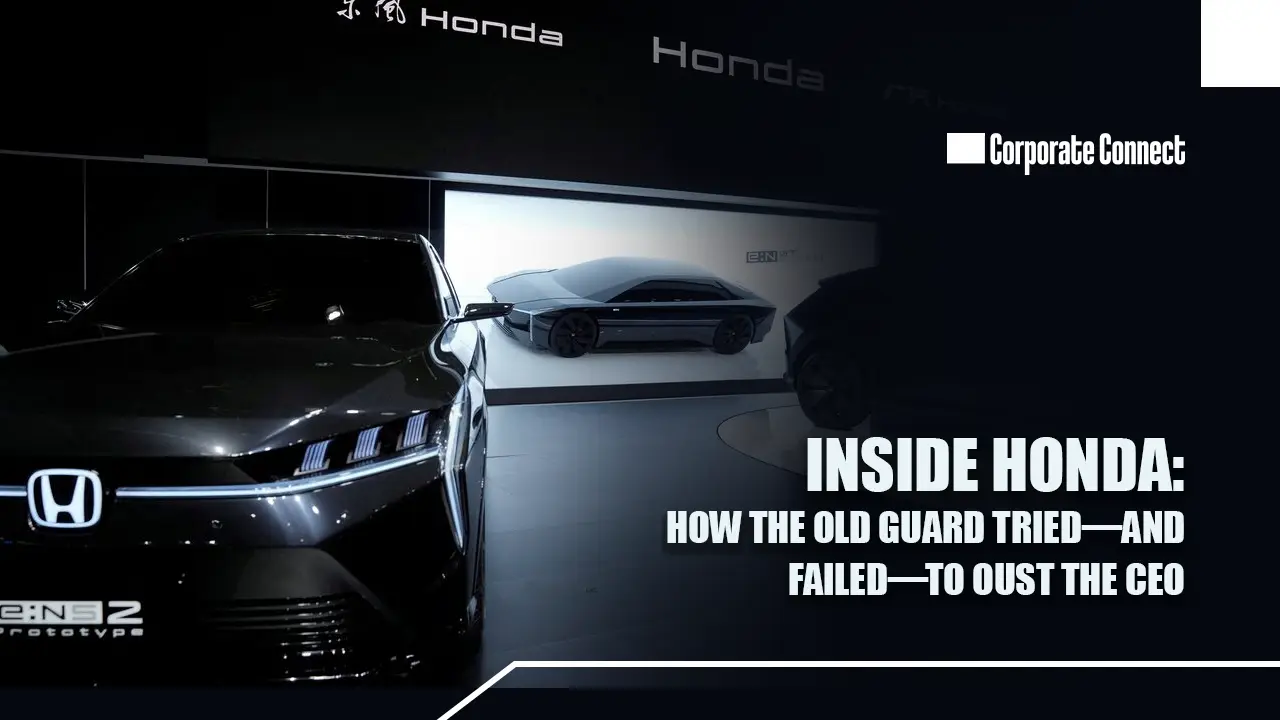
Tokyo: Towards the end of last year, a small group of retired Honda Motor executives began holding private meetings to talk about the problems facing the Japanese carmaker and the person they thought was to blame: Chief Executive Toshihiro Mibe.
According to a written account of their conversations that Reuters reviewed and interviews with two participants, they developed a case against the former engineer over months of text messages, meetings, and meals that occasionally included current executives.
They accused Mibe of ignoring China, the largest auto market in the world, and placing a “failed” wager on electric cars, which would cause Honda to suffer its first yearly loss in 70 years. He was accused of focusing more on Honda’s golf sponsorship than its business.
The old guard had had enough by April. Three people familiar with the meeting told Reuters that former CEO Nobuhiko Kawamoto, who took part in some of those discussions, visited Tokyo headquarters and instructed Mibe to step down.
Mibe, who is still in his position, did not change.
Although Japan’s industry is severely impacted, the Honda issue is representative of the difficulties faced by traditional automakers worldwide. Its automakers depend on the U.S. market, where President Donald Trump’s tariffs and reduction of EV subsidies are squeezing earnings. Conversely, Japanese consumers, who make up a small portion of that market, have showed little interest in EVs.
Honda and other companies must strike a costly balance between protecting their established industries and creating EVs to compete in other markets. With inexpensive, software-heavy cars that are released in a fraction of the time it takes the Japanese, who have spent decades concentrating on dependability through meticulous manufacturing methods, Chinese companies have come to dominate the EV market.
Last month, Honda abandoned Mibe’s commitment to become entirely electric by 2040 and wrote down over $9 billion in EV-related expenses after discontinuing the development of three vehicles. $12 billion might be the entire damage. This comes after competitors including Ford, GM, and Nissan scrapped plans for additional EV cars and assembly lines, collectively writing off more than $25 billion.
This narrative of Honda’s leadership blunders and chaos is based on interviews with twelve individuals, including important suppliers and current and past executives, as well as a review of conversations among the company’s alumni. It demonstrates how, despite losing the support of powerful previous executives, Mibe has managed to survive—at least for the time being—thanks to the board’s support.
In a statement sent in response to inquiries from Reuters, Honda claimed not to be aware of any conversations involving previous executives. In addition to implementing features like the newest driver-assistance software, the corporation stated that it was collaborating with suppliers to improve the automotive business through cost containment and resource reallocation.
Additionally, the automaker said that sports sponsorship was managed properly to strengthen its brand and satisfy CSR obligations.
In order to make up for the yearly loss, Mibe, who took over as CEO in 2021, would undergo a three-month compensation reduction of thirty percent. The former CEO, Kawamoto, acknowledged that he had met Mibe, but he would not elaborate. He still has a lot of power and has been known to step in during emergencies to remove a successor.
Honda is in a precarious situation just a year after a possible merger with Nissan failed. The company claims to be the biggest engine manufacturer in the world, powering everything from jets to snowblowers, but its illustrious engineering heritage might not be sufficient.
The author of “Driving Honda,” Jeffrey Rothfeder, stated, “I don’t know the way out for them.”It will undoubtedly be too late to change things in the near future.
DISREGARDING THE “ACTUAL PLACE”?
Soichiro Honda, the company’s late founder, left his mark on Honda for a long time. The son of the blacksmith was fiercely independent, irascible, and engine-obsessed.
The Civic and the Accord, two of the best-selling vehicles in the world, were created by his firm. Additionally, it is the creator of the Super Cub, the most well-known motorcycle ever.
However, their contacts reveal that Honda’s old guard was concerned that Mibe was abandoning the principles of the “Oyaji,” or old man. Focusing on the “genba,” or “actual place” where work is done, has been crucial to Honda’s success. This applies to Honda’s production floors, salesrooms, and the highways where its goods are utilized. For managers, losing sight of it is an unacceptable transgression.
The alumni stated, “The CEO does not see conditions on the ground or listen to customers, and doesn’t go to the genba,” as reported in the summary. “The CEO and other senior managers do not go to the genba. China, for instance.
According to one source, Mibe has rarely traveled since taking over as CEO, despite the fact that China’s zero-COVID policy prohibited such travels for a portion of his tenure. Rival bosses frequently attend China’s annual auto show, which is the largest event in the business, but he has rarely participated.
Honda’s market share in China plummeted under Mibe’s leadership, from 8% in 2020 to less than 3% last year.
Honda claimed that despite its efforts to become more competitive in a shifting market, its major focus remained on the Genba. It stated that the trip was done as needed but did not say how many times Mibe had traveled to China.
The alumni contended that Mibe was overly preoccupied with Honda’s golf sponsorship, which included playing rounds with the company-sponsored professional sisters Akie and Chisato Iwai.
Mibe’s arguments weren’t always supported by his communication. For example, the executives said that his advocacy of the EV-first plan occasionally came across as tone-deaf and lowered morale.
That obstinacy was somewhat a reflection of Honda. Koji Endo, chief executive analyst at SBI Securities, stated that Honda always tries to handle things independently. “This time, in the end, it did not go well at all.”
According to a person familiar with the talks, Mibe rejected a Japanese bank’s offer to sell up the EV firm this year.
According to the individual, the CEO stated that Honda would restore the EV company internally, but outside funding would have lessened the burden of the faltering operation.
Mibe told Reuters last month that the move had been considered, but “we’ve stopped pursuing that line of thinking for now.”
China was another place where Honda’s independence streak was evident. Already, Toyota and Nissan have been collaborating more closely with partners to develop EVs that meet local drivers’ needs. Honda only stated that it would follow suit this year.
SUPPORTED BY THE BOARD
According to one of the individuals, by the time Mibe met with Kawamoto in April, the Honda board’s nomination committee had already decided he could remain.
As regulators work to strengthen corporate governance, Honda, like many other Japanese companies, has recently expanded the number of independent directors on board committees. Another person acquainted with the automaker claims that this has diminished the influence of retired bosses.
Mibe and four outside directors make up Honda’s nomination committee, although he will leave it later this month.
When questioned if Mibe took part in the committee’s talks regarding his future, the automaker only stated that key selections were made in a proper manner. A request for comment was not answered by the chairwoman of the committee.
Since then, Mibe has presented a proposal to revitalize the financially troubled auto industry, which includes cutting the price of new hybrid powertrains by 30%.
However, two executives at Japanese Honda suppliers told Reuters they had not been engaged about possible cost reductions.
The performance of the auto unit has affected more than just the bottom line. According to the people, tensions within Honda increased as employees at the motorcycle division, which turned a record $4.6 billion profit last year, began to believe they were supporting the auto industry.
In February, Mibe relocated auto-development engineers from Honda to an R&D subsidiary, a move that may contribute to reviving the company’s innovative culture.
According to Rothfeder, this reversed a change made prior to Mibe’s administration that weakened the autonomy engineers had enjoyed for many years. “They lost thousands of important R&D players who didn’t want to work with marketing departments.”
According to the description of their conversations, some of the former executives voiced worry that engineers have since reverted to undesirable traditions, such as contracting out component design to suppliers. They claimed that this made cost control more difficult. Costs have not decreased, but Honda’s capacity to produce automobiles has, according to Endo.