
AL HL: India May Mandate Isobutanol Blending With Diesel Later This Year
AL HL: India May Roll Out Diesel Blending Mandate Later This Year, Says Road Transport Secy
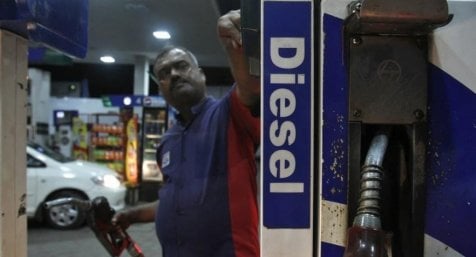
The Road Transport Secretary stated on Friday that the Bharat Petroleum Corporation had produced encouraging results and that a policy mandate could follow within months, indicating a significant expansion of the nation’s alternative fuels policy beyond its current ethanol-in-petrol program. India may implement a mandatory blending program for diesel with isobutanol later this year.
“Diesel blending has been thoroughly investigated. In order to combine isobutanol with diesel, Bharat Petroleum is already doing research. The outcomes are really positive. Diesel use is over twice that of gasoline, and it is quite probable that the blending regulation will begin to take effect later this year.
Therefore, blending diesel would have a much bigger effect on our energy security than blending gasoline, according to V. Umashankar, Secretary of the Ministry of Road Transport and Highways (Morth).
Isobutanol, an advanced biofuel made by fermenting ethanol, is a promising addition to diesel fuel since it produces more energy and corrodes less than ethanol.
According to the Petroleum Planning and Analysis Cell (PPAC), road freight, agriculture, and industrial use account for more than 41% of India’s total petroleum product mix in FY2025–2026, while petrol accounts for only 17%.
A draft notification requiring the production of automobiles compatible with E85 and higher ethanol blends for gasoline has already been released by the government. The next stage of a biofuel plan that has gained momentum over the last ten years would be the suggested diesel program.
At the Confederation of Indian Industry (CII) Multimodal Transportation and Logistics Summit in New Delhi, Secretary Umashankar informed BW Businessworld that complaints filed via the ministry’s upcoming QR code-based “Know Your Road” platform would not be available to the general public.
Although the project will enable residents to report maintenance problems and road faults as well as obtain information about road assets, authorities will use the grievance data internally to monitor redressal, evaluate the work of road maintenance agencies, and assess road conditions.
The Transition to Electric Freight Is Still Early
Umashankar admitted that the commercial trucking market has barely shifted, despite the quick rise in the use of electric vehicles by passengers. “The haulage and logistics industry is essentially nonexistent nowadays. He stated that penetration in trucks with higher power-to-weight ratios was “just a fraction about zero” and that it was less than a percentage point.
Approximately 95% of electric trucks delivered in India in 2024 weighed less than 3.5 tonnes and were utilized for short-distance urban delivery. They are appropriate for long-haul freight operations because just 280 units sold surpassed that criterion. This is in sharp contrast to China, which, according to a Niti Aayog report, sold more than 76,000 heavy-duty electric trucks in the same year.
The Niti Aayog research also stated that diesel truck financing rates are between 10 and 12 percent, whereas EV financing prices are between 15 and 18 percent because of battery longevity issues and operational uncertainties.
This disparity makes it challenging for fleet operators to clinch their business case without subsidies. Due to high upfront expenses and restricted access to financing, small and medium-sized freight operators—who own more than 70% of India’s trucks—face the greatest obstacles.
According to him, the shift in freight would necessitate a reconsideration of operational models in addition to vehicles. A draft framework for tractor-trailer interchangeability, in which the tractor unit is disconnected and recharged independently while the cargo trailer stays in use, is being developed by the ministry.
“What we’re looking at is a tractor-trailer interchangeability, where you can replace the entire front portion of the truck instead of just the battery. The charging takes place at designated areas, and the shipment flows smoothly,” Umashankar stated.
He pointed out that conventional battery switching is logistically difficult at scale because even replacing the batteries in huge freight vehicles would require overhead crane equipment.
Hydrogen Shows Potential, but Infrastructure Is Still a Barrier
Umashankar stated that experimental deployments of hydrogen-powered vehicles have proved promising. Following the commissioning of government-funded refueling infrastructure, hydrogen buses were already running on routes connecting Delhi, Faridabad, and Noida.
“On fuelling, it travels 450 kilometres before it meets a refuelling,” he stated. “Delhi to Mumbai has a corridor that, with maybe three refuelling stations along the highway, the hydrogen bus or hydrogen truck can very well travel from Delhi to Mumbai.”
The deployment of refuelling stations, according to him, is a one-time capital investment, and the crucial next step is to strategically place those stations along freight corridors. “The only high-cost element there is the hydrogen refuelling stations,” he stated.
A Strategic Priority for Critical Minerals
Umashankar further highlighted China’s hegemony in the field of essential mineral refinement as a long-term necessity for India’s aspirations for electric transportation. “China has been able to take a leadership role in this area primarily on account of its refining technologies which come at very low cost… its strength lies in critical minerals refining and that’s where it is leading the rest of the world,” he stated.
He stated that in order to maintain its long-term strategic position, India will have to have equivalent refining capabilities at competitive prices.
Costs of Logistics Drop, but Structural Gaps Remain
According to CII and Knight Frank’s joint report, “Fast-Tracking MMLPs to Enable Modal Shift,” cumulative infrastructure investment of almost USD 360 billion helped reduce logistics costs from 13–14% of GDP ten years ago to 10–10.7% in FY26, resulting in estimated yearly savings of USD 123–133 billion. In the World Bank Logistics Performance Index, India’s position rose from 54th in 2014 to 38th in 2023.
To reach its 2047 freight modal shift ambitions, the nation would require 216 multimodal logistics parks, each handling roughly 16–17 million metric tonnes yearly, according to the analysis. The main barriers to moving goods to rail and other cost-effective modes were found to be excessive reliance on roads, sluggish MMLP development, and poor first- and last-mile connection.
Given how closely packed the middle of the table is, Umashankar admitted that the LPI ranking improvements were brittle. A two-point improvement would bring India from 38th to roughly 12th globally. He stated that the two areas that require the most attention are track-and-trace and customs clearance, both of which are outside the direct purview of his ministry.