

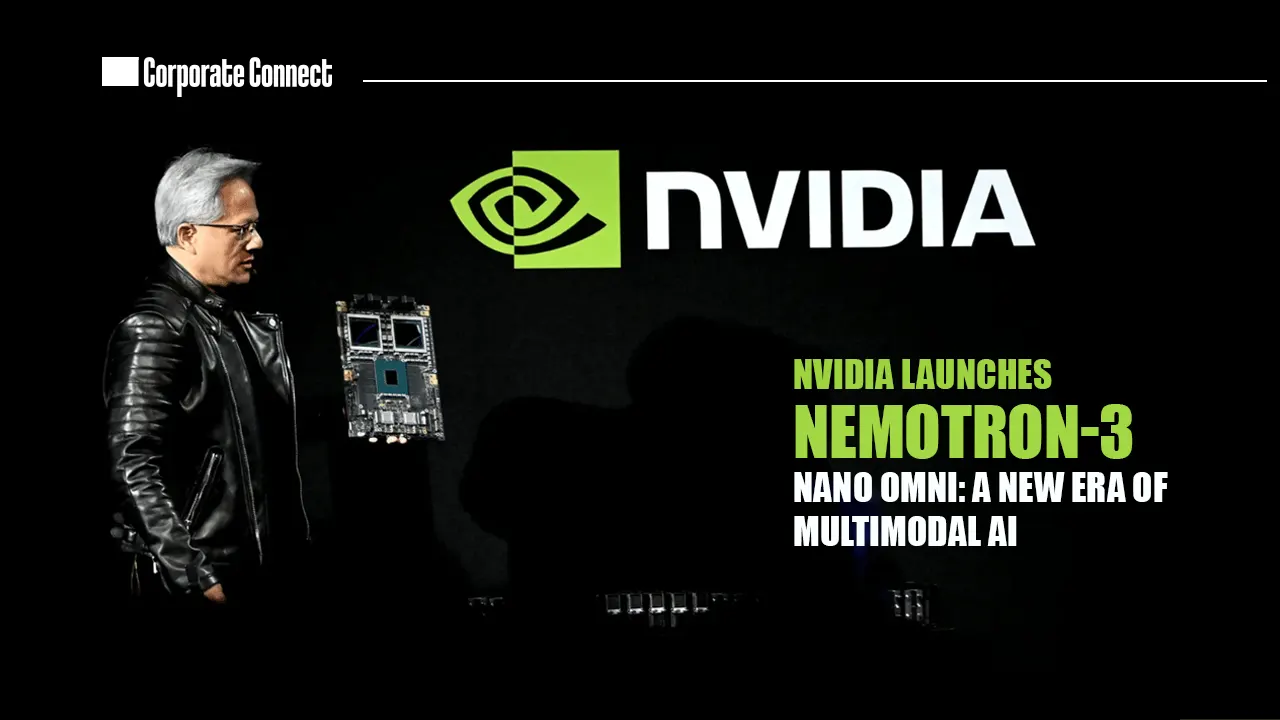
The goal in the rapidly developing field of artificial intelligence has long been to create machines that can simultaneously perceive the environment through sight, sound, and language. That view remained disjointed for years, pieced together via a cumbersome series of specialized instruments. One “sense” was handled by each, and outputs were sent down a digital conveyor belt.
NVIDIA made a significant move to put an end to the fragmentation on April 28, 2026. The firm introduced something more cohesive with the release of Nemotron-3 Nano Omni: a unified intellect that observes environs in addition to processing inputs.
From a pioneer in graphics to an AI powerhouse
Understanding the organization behind this change is helpful in appreciating its significance. NVIDIA, which was formerly associated with gaming GPUs, is now the foundation of the AI industry. It has developed into a full-stack AI behemoth under CEO Jensen Huang, creating both the software ecosystems that teach machine learning and the hardware that drive it.
Today, NVIDIA is actively designing the AI revolution rather than only taking part in it.
The Journey to “Omni’
The Nemotron series has followed the general path of artificial intelligence. Though limited to language, the older Nemotron-2 models performed exceptionally well in text coding, reasoning, and mathematics. By late 2025, AI was able to plan and carry out multi-step tasks with startling autonomy because to the Nemotron-3’s introduction of “agentic reasoning.”
Even so, perception was still compartmentalized.
That is altered by the Nano Omni. It effectively gives the model “eyes” and “ears” in addition to “brain” by fusing reasoning with innate multimodal abilities. It processes everything in a single continuous loop rather than contracting out vision and audio to different units. AI becomes more intuitive as a result, in addition to being faster.
Ending the “Lost in Translation” Era
In the past, it took several stages to analyze anything as basic as a video: extracting frames, transcribing audio, and feeding both into a language model. Latency and the possibility of losing subtlety were introduced at each phase.
That friction was removed by Nano Omni. It captures tone, gesture, and context in real time while simultaneously interpreting audio, visual, and video. A conversation is now an interplay of expression, timing, and intent rather than just words. Results may be produced much more quickly and accurately because to this integrated understanding.
Useful Assistance for Regular Professionals
The real value of this technology is how it saves time for people across various sectors:
- In the Office: Because Nano Omni can “see” high-resolution screens clearly (1080p), it can navigate complex software like accounting or design tools just like a human would, handling boring data entry that used to take hours.
- In Logistics: A manager can ask the AI to “scan the last four hours of the loading dock footage and tell me why the 2 PM shipment was delayed.” The AI scans the video and audio in seconds, providing a summary that would have taken a human half a day to compile.
- For Customer Support: It powers smarter kiosks that can see what a customer is pointing at on a menu while listening to their order, making interactions feel natural rather than robotic.
A shift bigger than speed
of the end, Nemotron-3 Nano Omni symbolizes a change of perspective. Users no longer need to adjust AI in order to learn prompts, organize queries, and streamline communication. Rather, technology is changing to fit us.
NVIDIA is lessening the cognitive strain of dealing with robots by unifying perception. Professionals may now concentrate on strategy, creativity, and decision-making instead of serving as middlemen and converting real-world issues into machine-readable procedures.
The Final Score
This is not your typical model release. It’s the discreet removal of a long-standing AI design constraint.
NVIDIA is advancing the industry toward a time when machines will be able to understand as well as compute thanks to Nano Omni. By doing this, productivity is being redefined as producing more meaningful work rather than just more labor.