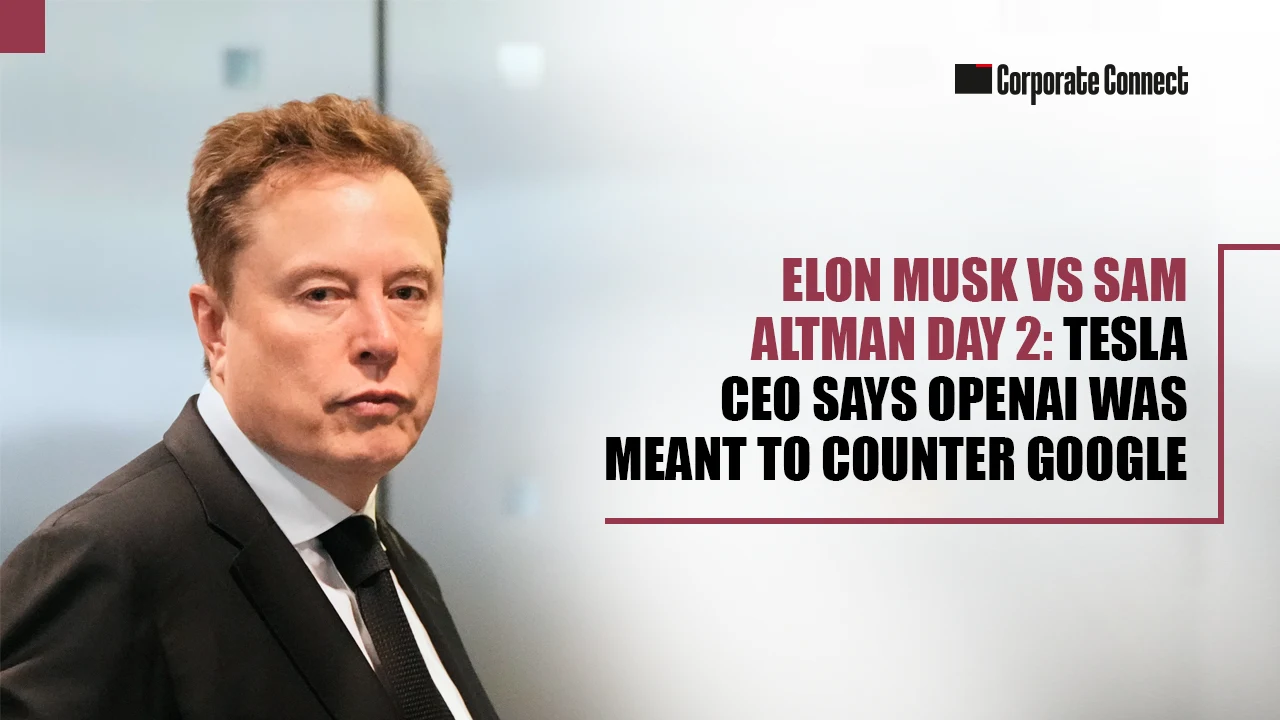
Elon Musk told the jury during his testimony on Tuesday in a federal courtroom in Oakland, California, that he created, named, and funded OpenAI with the express understanding that it would never be operated for personal benefit. Judge Yvonne Gonzalez Rogers began the second day of the high-stakes legal battle between OpenAI CEO Sam Altman and the richest man in the world. Both Altman and Greg Brockman, the president of OpenAI, were in the courtroom.
Elon Musk claims that OpenAI was founded to oppose Google rather than to generate a profit.
Musk, the CEO of Tesla, arrived before court in a black Cadillac and told the judge that his initial goal in contributing to the founding of OpenAI was to develop an open-source, nonprofit alternative to Google, whose artificial intelligence strategy had caused him great distress.
Musk claimed that after a furious dispute with Google co-founder Larry Page, the concept took shape.
Musk stated, “I could have started it as a for-profit, and I chose not to,” when testifying. “I chose to make it something for the benefit of all humanity.”
According to Elon Musk’s testimony, Larry Page called him a “speciesist for being pro-human.”
Musk testified that the Google co-founder had ignored his concerns about safety by branding him “a speciesist for being pro-human.” He described the falling out with Page that he claimed solidified his misgivings about AI development.
Musk told the court that he was certain that a distinct, safety-focused nonprofit organization was required because he thought Page was not taking the dangers of advancing artificial intelligence seriously.
Elon Musk asserts that he came up with the concept, the name, and the key personnel.
When questioned by Steven Molo, his primary trial lawyer, Musk gave a broad explanation of his involvement in the establishment of OpenAI, presenting himself as the impetus behind the company’s development.
“I came up with the idea, the name, recruited the key people, taught them everything I know, provided all the initial funding,” Musk stated.
Regarding OpenAI’s founding charter, Elon Musk said, “No Person Shall Benefit From This Charity.”
The 2015 founding charter of OpenAI was presented as evidence by Musk’s legal team and shown to the jury on a courtroom monitor. According to the statement, OpenAI is “not organized for the private gain of any person” and aims to develop “open source technology for the public benefit.”
Musk, the founder of xAI, stated that the phrasing was intentional.
“It was specifically meant to be for a charity that did not benefit any individual person,” he stated.
“Charitable Giving in America Will Be Destroyed If the Verdict Comes Out That It’s Okay to Loot a Charity,” Musk warns.
Musk expanded his argument beyond the details of his own case, telling the court that the trial had ramifications for charity nationwide—comments that prompted an instant protest from OpenAI’s legal team.
“If the verdict comes out that it’s okay to loot a charity, charitable giving in America will be destroyed,” he stated.
“As long as the tail didn’t wag the dog” is how Elon Musk describes a for-profit subsidiary.
Musk admitted that early conversations on how to maintain the organization’s financial viability had included the potential of creating a for-profit component. He stated that while he had a clear condition linked to his support, he was not wholly against such a system.
“We talked about and came up with several ideas for funding the organization. We did discuss becoming a for-profit or having Tesla finance it,” Musk stated. “As long as the tail didn’t wag the dog, essentially.”
Musk on AI and Humanity’s Future: “It Could Make Us More Prosperous, But It Could Also Kill Us All”
Musk gave the jury a dismal but vivid appraisal of the technology’s potential courses in what may have been the most dramatic section of his testimony, outlining his perspective on the stakes in developing AI.
It might increase our wealth, but it might also result in our deaths,” he stated. “We want to be in a Gene Roddenberry movie, like Star Trek, not so much a James Cameron movie, like Terminator.”
Elon Musk Compares Raising Children to Training AI in Court
Musk used an analogy that he claimed illustrated both the significance and the boundaries of human oversight over the systems being created in an attempt to convey the philosophical basis of his concerns regarding AI safety.
It would be similar to having a really intelligent child. You can’t truly manage a child once they grow up, but you may try to instill the appropriate values in them. Essentially, he stated, “honesty, integrity, caring about humanity, and being good.”
Musk believes that “as soon as next year,” AI will surpass human intelligence.
Musk told the court that he believed artificial general intelligence to emerge sooner than most observers anticipate, providing a timescale that highlighted the seriousness he attached to issues of AI governance and safety.
As early as next year, AI would likely be as intelligent as any human, he predicted.
“Better Human-AI Symbiosis” is Elon Musk’s statement regarding Neuralink and AI safety.
Musk told the court about his work at Neuralink, a brain-computer interface firm, and how the company’s long-term goals were linked to the same safety concerns that drove him to start OpenAI.
“The long-term goal of Neuralink was actually AI safety, in the sense that if we can closely tie the human world to AI, basically if we’re going to achieve better human-AI symbiosis, then we’re more likely to have a future with AI that is good for humanity,” he stated.
“Musk Never Cared About AI Safety,” OpenAI stated in court.
William Savitt, the lawyer for OpenAI, directly contested Musk’s explanation of his objectives in his opening remarks. Savitt contended that Musk’s real complaint was about control and ambition rather than nonprofit ideals. OpenAI’s non-profit status never bothered Musk. “He never gave a damn about the safety of AI,” Savitt remarked. “What he cared about was Elon Musk on top.”
Savitt informed the jury that Musk had “bullied” other founding team members with his $1 billion financial pledge and that “we’re here because Musk didn’t get his way at OpenAI.”
OpenAI openly said that it “can’t wait to make our case in court where both the truth and the law are on our side,” characterizing the lawsuit as a frivolous “harassment campaign.”
Elon Musk’s Goals for the Trial
Initially, Musk demanded damages of up to $134 billion from OpenAI and Microsoft, a co-defendant in the dispute and one of the company’s biggest sponsors. Since then, he has changed his mind and is now requesting that all “ill-gotten gains” be sent to the OpenAI charity instead of being given to him directly.
In October, OpenAI underwent a significant reorganization, eliminating its profit cap under its redesigned for-profit organization, which is nonetheless governed by a nonprofit foundation. In its most recent investment round, the corporation went on to raise $122 billion.
What Comes Next in the Trial of Elon Musk and Sam Altman
Following the anticipated continuation of Musk’s hearing on Wednesday, his legal team said it will ask Jared Birchall to testify. In addition to holding managerial positions at xAI and Neuralink, Birchall oversees Musk’s funds through his family business, Excession LLC.
A number of well-known witnesses are anticipated to testify throughout the four-week trial, including Microsoft CEO Satya Nadella, prominent AI researchers, and current and former OpenAI board members.