
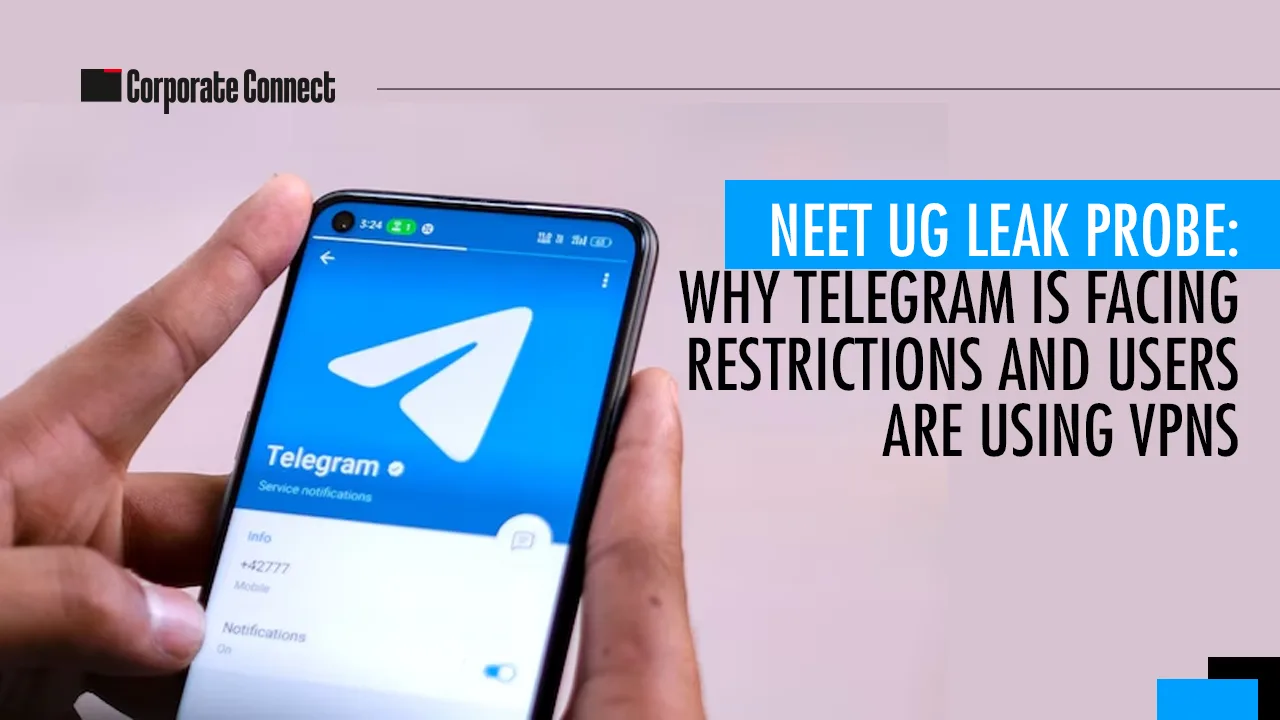
Earlier this week, Telegram access was prohibited in India due to an ongoing investigation into alleged National Eligibility-cum-Entrance Test Undergraduate (Neet-UG) paper leaks. The initial impact of the prohibition on fraudulent networks already functioning across services was limited since students studying for the test quickly moved their study materials to other platforms or VPN-enabled access.
Sultanpur, Uttar Pradesh resident Prakash, a repeat Neet candidate, claimed to have already experienced an interrupted test round. Due to a proven paper leak covering up to 140 questions, his exam was postponed from May 3 to June 21. Telegram was blocked in India a few days prior to the new date.
He is now concentrating on his studies after moving his notes to WhatsApp and moving his lectures to YouTube through his coaching, which gave them access to Google Drive.
“As long as the system does not improve, nothing will happen, regardless of the force or system. Because of the transportation and ministry, the document leaks on Telegram via your system. He expressed his lack of faith in the system by telling BW Businessworld, “Only the people inside leak the paper.”
He claims that the government’s directive focused on the symptom rather than the illness. “The document leak is the main issue here. Assume the toppers are in good condition. However, the most impacted students are the average ones. Additionally, he said, “middle-class students are caught in this loop.”
Why Was There a Ban?
Two directives were included in the Ministry of Electronics and Information Technology’s decision under Section 69A of the Information Technology Act. The first was a blunt tool, removing Telegram from Google and Apple’s Indian shops until June 22. The second was more drastic: Telegram was given additional instructions to stop allowing users to modify messages in India until June 30.
The NTA has expressly identified the editing feature as a structural flaw. In order to make a document appear to have been shared prior to the exam, Telegram allows channel admins to alter attached files within a message while maintaining the original timestamp.
Several channels operating under the names “PAPER LEAKED NEET,” “Re-Neet 2026,” and “Private Mafia” were reported by the NTA for allegedly requesting fees ranging from a few thousand to several lakh rupees for alleged test material. The agency insisted that these outlets were conducting fraud and not disseminating actual content, and that there were no real leaked documents outside the guarded review chain.
Google Trends data revealed a dramatic increase in searches for “VPN for Telegram” right after the limitation went into force on June 16. Search activity, which had been little prior to the injunction, increased throughout the day and peaked on June 17, suggesting that users were actively looking for ways to get back into the platform rather than giving up.
Considering Telegram’s size in India, the development is noteworthy. According to a Statista survey, 45% of Indian respondents said they routinely use Telegram, which is the highest percentage of any country surveyed. India outperformed Brazil, Mexico, South Africa, and Spain, highlighting the platform’s significance as a hub for coaching groups, educational communities, and extensive information exchange in addition to its use as a messaging tool.
By Thursday night, ProtonVPN announced that hourly registrations from India had increased by 150%. However, Downdetector recorded a substantial increase in Telegram complaints, with 42% coming from Delhi, 31% from Telangana, 16% from Kerala, and 10% from Tamil Nadu. In the 24 hours after the directive, StatusGator received 1,489 user-submitted reports. Additionally, screenshots of Telegram operating normally using VPNs were making the rounds on social media.
While acknowledging the limitations, NTA Director General Abhishek Singh added that the prohibition would assist reduce the reach of fraudulent channels during the re-examination window but could not be 100% effective when VPNs were utilized. He advised candidates to view the NTA’s official website, registered email address, and SMS as the only reliable resources for exam-related information.
It was referred to by the Internet Freedom Foundation as “an easily avoided solution.”
Telegram was banned for a week by India’s IT ministry after some users exchanged test questions that had been leaked. This punishes more than 150 million regular Telegram users in India, not the insiders who disclosed the exam papers. Furthermore, nothing has been halted by the ban. Pavel Durov, CEO of Telegram, stated via the social media site X (previously Twitter) that “the leaks just moved to other apps.”
Students Bear The Cost
Instead of resolving the fundamental problem, the restriction made preparation more difficult for candidates. Updates, peer conversations, and coaching materials that were previously shared on Telegram had to be moved to YouTube or WhatsApp. Students claimed that in addition to fraudulent channels, legitimate academic ecosystems were disturbed.
“Many students use Telegram to conduct really helpful doubt-solving groups, share notes, and receive exam information. A blanket barrier affects all of that.Shooting the messenger is what this is. The scam only shifts to the next platform; it doesn’t go away. According to Prempreet Singh, CEO and founder of SkillBytes, “the action treats the symptom, not the disease.”
The policy’s most obvious failure, according to her, was the discrepancy between who the ban was intended to target and who it actually harmed.
“I only learned about VPN this week,” he remarked, noting that the majority of candidates he knew were more concerned with getting ready than getting around limitations or getting over platform bans.
While many students won’t be able to utilize a VPN, some will. As a result, you penalize the less resourceful candidate while the motivated fraudster gets around it in a matter of minutes. “That is a needless and totally preventable situation,” Singh stated.
Priya, a Patna second-year candidate who requested to be named solely by her first name, had given up on the system’s ability to keep her safe.
“Whenever something goes wrong, a new committee, rule, or prohibition is created. All we’re doing is getting ready for the test. The papers are not being leaked by us. However, we are always the ones who have to deal with the fallout,” Priya remarked.
How Leak Channels Work
With end-to-end encryption on private chats, generous document sharing, and big public channels that can reach hundreds of thousands of members without active moderation, Telegram fosters an environment where fraud networks and student study groups coexist. It was operationally useful for creating timelines that suggested pre-exam access to papers because of the message-editing loophole.
“Blocking at the platform level is frequently a temporary confinement strategy rather than a long-term fix. Bad performers are very flexible. “They use VPN-enabled access or migrate across platforms,” stated Shreya Sharma, CEO and founder of Rest The Case.
The proportionality of the app-store delisting, as opposed to the feature-level limitation, is at the heart of Telegram’s challenge to the government’s order before the Delhi High Court.
Platform blocking, according to Sharma, is essentially a short-term containment strategy that lowers visibility but does not completely eradicate fraud. The long-term effects of such interventions on organized fraud networks are limited, she pointed out, because operators simply switch to other platforms or encrypted services.
“While determined offenders continue to operate through other routes, blocking primarily affects ordinary users,” she stated. Feature-level limitations would be more successful than complete platform bans, according to Sharma, especially when it comes to tools that are used to falsify evidence or alter timestamps.
Anonymous accounts, VPN circumvention, and cross-border jurisdictional delays were among the enforcement issues she brought out. Instead of recurring platform limitations, she claims that more robust KYC enforcement, stricter examination security, and financial traceability are necessary for durable solutions.
BGP Dispute and Legal Challenge
Pavel Durov, the founder of Telegram, also claimed that the disruption went beyond app store delisting to include Border Gateway Protocol hijacking, a tactic where a network pretends to be the preferred routeing path to Telegram’s IP addresses, rerouting traffic. He stated that consumers in the UAE had been affected by Autonomous System AS18101, which he identified and attributed to Reliance.
There was a significant mistake in the accusation. AS18101 is owned by Reliance Communications, which has been bankrupt since 2019 and has long since ceased mobile operations. The operational entity, Reliance Jio, operates under AS55836. Jio denies being involved.
Recent posts on X have sparked rumors of a BGP route misconfiguration and Reliance Jio Infocomm Limited (AS55836). To be clear, Jio has not been a part of any such occurrence. Jio stated that it still operates its network in compliance with the highest standards of dependability, security, and transparency as well as international Internet routing best practices.
Additionally, Durov claimed that Reliance and WhatsApp might have pushed for the ban as part of a “competitive war.” The assertion has not been substantiated by any evidence, and neither Reliance nor Meta have offered a meaningful response.
Additionally, Durov claimed that Reliance and WhatsApp might have pushed for the ban as part of a “competitive war.” The assertion has not been substantiated by any evidence, and neither Reliance nor Meta have offered a meaningful response.
A Loop That Must Be Broken
Prakash, who was also involved in the discussions surrounding the Neet-UG 2024 exam, which came under scrutiny after an unusually high number of students reportedly scored a perfect 720/720, stated that the exam system’s frequent disruptions continue to cause uncertainty for candidates, with some having to reappear because of administrative or procedural issues.
Correcting your failure is the best course of action. Why is Telegram being banned? How does Telegram handle the paper? The paper is sent via your system to Telegram. The paper is only leaked by those inside. Until the leak is fixed, rather than the channel it passes through, the cycle of drop year, ban, new committee, drop year again for kids won’t end,” he stated.