
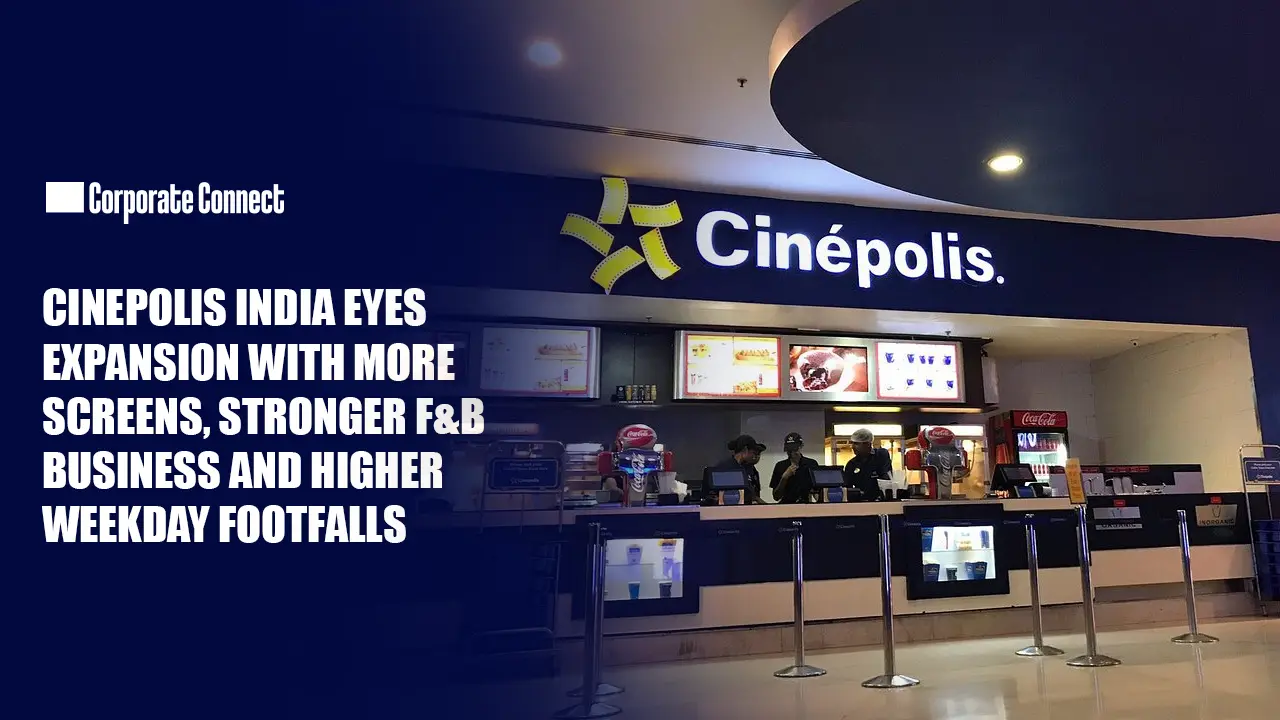
As moviegoing habits change after the epidemic, Cinepolis India is focusing more on growing its footprint, boosting its contribution to food and beverage (F&B), and increasing weekday foot traffic. According to Devang Sampat, managing director of Cinepolis India, the multiplex chain intends to add about 40 screens a year while aiming to raise its F&B contribution as a percentage of the box office to 70 to 75 percent.
The company will continue to seek catchment-led expansion rather than a metro versus non-metro strategy, according to Sampat in an interview with BW Businessworld. The company intends to add nearly 20 screens annually through direct investment and another 20 through franchise and operation-management methods.
In addition to growing, Cinepolis is making investments in premium formats, food partnerships, menu innovation, and digital infrastructure across the customer journey, all the while maintaining accessibility by keeping average ticket price growth below inflation.
The MD also mentioned advertising as a rapidly expanding source of income for the business. Regarding consumer trends, Sampat observed that although the frequency of moviegoing has decreased since the epidemic, viewers are moving more and more toward weekday viewing and more deliberate trips to the movies that are focused on compelling content.
Catchment-driven Growth
The next stage of Cinepolis’ growth will be catchment-led rather than metro vs. non-metropolitan. According to Sampat, the company assesses growth prospects using a “5 to 7 km” catchment radius instead of city tiers, contending that proximity, mall quality, infrastructure, and the entire customer experience are more important than whether a location is in a metro or Tier 3 market. “Many non-metros are overcrowded, and many metro areas still have virgin areas,” he stated.
Because of India’s low screen density, Sampat thinks there is still a lot of space for growth in the country’s movie theater industry. There are currently about 10 movie theaters per million inhabitants in India, whereas developed markets have far over 100. “The whitespace is real,” he added, noting that moviegoers are increasingly choosing local theaters over long trips.
Cinepolis is relying on its Franchise-Owned, Company-Operated (FOCO) model to sustain expansion while managing growing real estate prices and mall supply limits. Under this arrangement, Cinepolis invests the remaining funds and oversees operations, with developers bearing “70 to 90 percent” of the construction outlay. Under the FOCO model, the company presently runs roughly “50 screens,” which Sampat claimed allows it to remain near to consumers in catchments where economics could otherwise be challenging.
In terms of growth, Cinepolis intends to add about “20 screens a year” through direct investment and an additional “20 through franchise or operation management.” This amounts to about “10% growth year on year” on its foundation of almost 500 screens. According to Sampat, each screen investment costs roughly “Rs 3 crore,” and the total investment mix is adjusted based on the catchment opportunity between partner-led capital and the company’s balance sheet.
Bigger F&B Role, Higher Weekday Footfalls
Although box office will still be Cinepolis India’s main source of income, the company is progressively attempting to diversify its revenue mix by looking beyond ticket sales. According to Sampat, advertising has already increased “much faster than inflation and well ahead of box office growth,” and over the next three to five years, it is anticipated to contribute more. In order to accelerate that pace, he continued, Cinepolis intends to expand its digital advertising inventory through its “It’s Spotlight” network.
It is anticipated that F&B will be even more important to the company’s expansion plan. According to Sampat, over the coming years, Cinepolis hopes to raise its F&B contribution as a percentage of the box office from roughly “50 percent” to “70 to 75 percent.
He described it as an “ambitious but realistic middle point” and stated that menu innovation, closer ties with top food brands, and a sharper “price-value architecture” to enhance customer perception and encourage repeat business will be the main drivers of the expansion. “Just as important as the number is how we get there,” he stated.
Sampat stated that Cinepolis monitors a number of operational parameters to assess business trajectory, even if the company does not reveal precise sales projections. These include raising weekday admissions, which have already increased to “15 to 16 percent” of weekly foot traffic from “9 to 10 percent” previously, maintaining average ticket price (ATP) growth below inflation, increasing F&B contribution, and increasing the number of screens by almost “10 percent year on year.”
Balancing Premiumization With Accessibility
Premium experiences are a growth lever for Cinepolis, but not at the expense of affordability. Despite making up “less than 20 percent” of premium multiplexes, Sampat claimed that Hollywood is still the driving force behind premium formats in India. He emphasized the company’s emphasis on unique experiences by stating that Cinepolis was the first in India to introduce 4DX and the Junior Kids’ auditorium format and that its proprietary high-end large-screen format, MacroXE, now makes up about “10%” of its screens.
“Premium and accessible are not a trade-off for us; they are co-equal,” he stated, adding that in order to preserve affordability and increase foot traffic, average ticket price increases have been kept at around “3 percent year on year,” below inflation.
In addition to ticket sales, Cinepolis is placing bets on food and beverage (F&B) to enhance the cinematic experience and increase patron spending. According to Sampat, the company views food and beverage as an essential component of a customer’s “night out” and is investing in menu innovation, collaborations with top food companies, and programs like the Blockbuster Food Festival.
“When we get the experience right, customers stay longer and return more frequently, which naturally benefits the rest of the business,” he stated.
Regarding technology and other formats, Sampat stated that Cinepolis already screens about “1,200 titles a year,” which is the biggest content slate for any movie theater chain worldwide. In addition, Cinepolis is experimenting with live events, sports screenings, and niche-language material.
However, “less than 1%” of all ticket purchases currently come from these formats. Instead, in order to make the consumer trip “future-ready,” the company’s greater IT investments are concentrated on enhancing the movie-going habit through seamless digital infrastructure across ticketing and in-theater touchpoints.
Data-led Customer Engagement
Cinepolis’ strategy regarding occupancy, retention, and targeted engagement is becoming more and more shaped by data and customer insights. With more than “one crore members,” the company’s loyalty program, Club Cinepolis, has one of the most comprehensive datasets on the behavior of Indian moviegoers, according to Sampat.
He added, “The insights from that base are what tell us things like how patterns have shifted post-Covid.” These insights also assist content partners better identify audience preferences and genre affinities and maximize marketing expenditures.
Cinepolis anticipates that the next stage of expansion will be more focused customer interaction. Instead of depending on widespread promotion, Sampat claims that the company is concentrating on using customer data more effectively to reach consumers with films that are in line with their interests. “It is far more efficient to reach a customer who has demonstrated a clear preference for a particular genre with the right film at the right time than to spray a wide marketing net,” he stated.
Cinema Visits Becoming More Intentional
According to Sampat, moviegoing habits have changed dramatically since the pandemic, with people choosing more carefully what and when to see rather than completely giving up on going to the movies. He stated that the solution is to make movie theaters “more experiential, not less,” even as live events have become a more formidable rival.
Cinepolis increased its presence in India from about 300 to almost 500 screens in spite of the Covid disruptions, demonstrating the company’s sustained faith in theatrical entertainment.
On the other hand, watching habits have changed more significantly. Weekday admissions, particularly on Tuesdays, have increased from “9 to 10 percent of weekly footfalls to 15 to 16 percent,” according to Sampat, even though the number of films shown annually has decreased from about five to about 3.5. People are still going to the movies.
He said that content producers are “unlearning and learning” how to adapt to shifting consumer expectations. “They are choosing different days, different occasions, and concentrating their visits around the films they really want to watch,” he said.
Cinepolis believes that experience and accessibility will be important growth factors in the future. Sampat described India as a “largely under-screened” market, claiming that viewers are reluctant to drive great distances to see movies and are increasingly choosing local theaters. In order to make the experience “future-ready,” the firm is improving the ticketing, theater infrastructure, and food and beverage aspects of the consumer trip.