
-by Shraddha Pandey
How Mukesh Ambani turned a forgotten cola into a weapon — and why Coca-Cola and Pepsi are losing sleep over it.
In a small Andhra Pradesh town, a bottle of cola is resting on a store counter. The price is ₹10. It’s chilly. It’s bubbly. Additionally, your grandfather would recognize its logo right away.
It’s not Coke in that bottle. It’s not Pepsi.
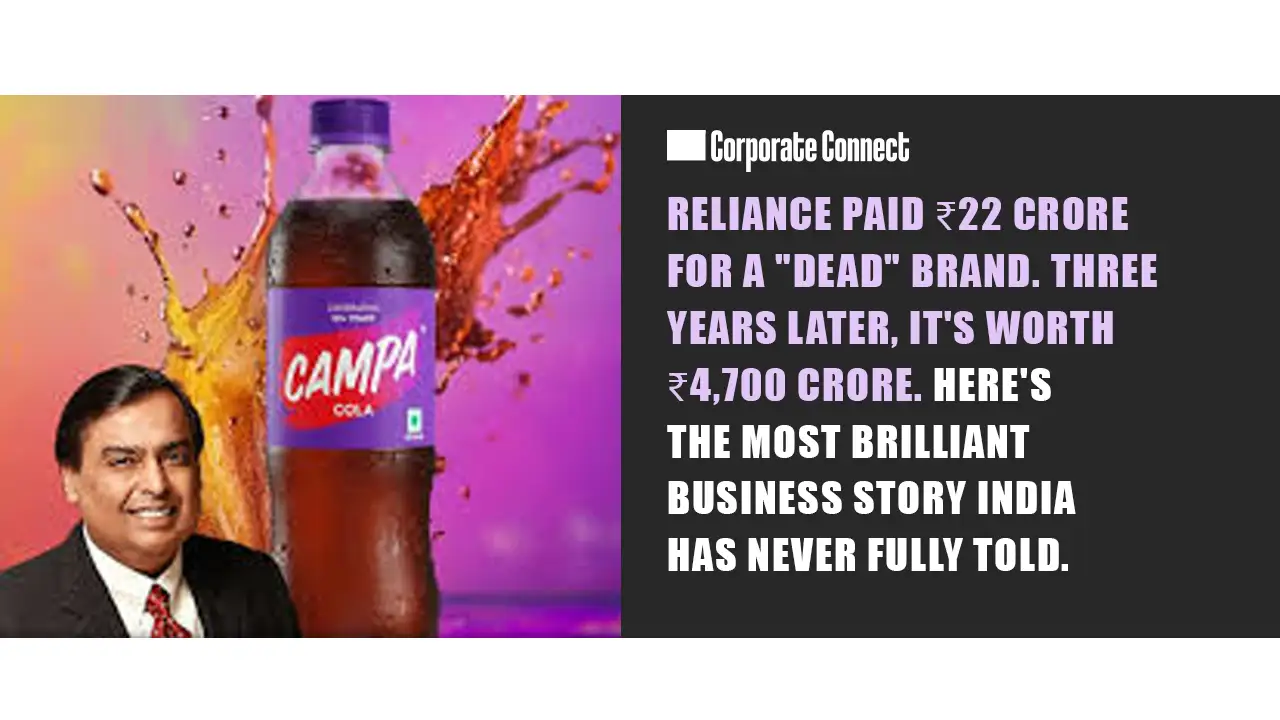
It’s Campa Cola—and the fact that it exists again, thriving, growing, and eating into the market share of two of the most powerful brands on the planet, is one of the most breathtaking business comebacks in Indian history.
This is the tale of how a once-dead brand was purchased for ₹22 crore, completely rebuilt, and transformed into a ₹4,700 crore empire in less than three years.
The Birth of a Nation’s Cola
You have to go all the way back to 1977 to comprehend why Campa Cola’s comeback is so potent.
From 1949 till 1977, the Pure Drinks Group was the first company in India to bottle Coca-Cola. For nearly three decades, they made Coca-Cola for India — every bottle, every sip, every fizz.
Then everything changed.
Foreign companies were subject to new protectionist regulations in 1977, which included a mandate that Coca-Cola disclose its infamously secret formula. Instead of taking the unimaginable, Coca-Cola quickly pulled out of the Indian market. That left its sole Indian distributor, Pure Drinks, with several empty factories, thousands of employees with nothing to do, and lots of cola-making supplies.
This was the time. An entire nation of cola drinkers — and no cola.
When the Indian government made Coca-Cola leave the market, Campa Cola became well-known. Campa Cola swiftly became a household name, particularly in North India, filling the void left by Coke during a period when the nation was opening up to Indian-made products. With varieties including Campa Cola, Campa Orange, and Campa Lemon, the brand became part of everyday life. “Campa ho jaaye?” is a colloquial expression that encapsulates the brand’s social integration.
“The Great Indian Taste” was the brand’s catchphrase, which was an open, direct appeal to Indian nationalism.
Campa Cola was more than just a beverage for more than ten years. It was a beverage from India. The Desi substitute. The evidence that India could satisfy its hunger without the assistance of foreign businesses.
The Fall That Nobody Could Stop
Then 1991 arrived. The doors of liberalization opened as a result.
Under the liberalization strategy, India opened its economy in 1991. Global behemoths like Pepsi and Coca-Cola soon made their way back to India with enormous marketing budgets, beautiful advertisements, celebrity endorsements, and stylish packaging. Campa Cola was unable to compete. Its factories slowed down, its distribution shrank, and slowly, it faded away from store shelves. For the majority of Indians, Campa Cola had faded into memory by the late 1990s.
Consider how those in charge of Campa felt at that very time. They had created something out of nothing. For fifteen years, they had satisfied a nation’s hunger. They had produced something genuinely Indian.
When the big corporations returned with their billions of dollars, worldwide supply networks, and Hollywood-style commercials, they utterly destroyed it.
Better technology, more distribution channels, bigger marketing budgets, and more powerful branding were all available to these multinational corporations. Campa Cola, on the other hand, suffered with distribution and exposure, particularly outside of its traditional strongholds in the North, and its reach became constrained.
Campa Cola had completely disappeared from the conversation by the 2000s. It was present in pockets: a bottle here, a recollection there, a ghost of its former self.
The brand’s annual revenue had dropped to just ₹22 crore by the time Reliance discovered it.
Dead. Forgotten. Over. Or so everyone thought.
Mukesh Ambani Sees What Nobody Else Can
Reliance Consumer Products Limited did something in August 2022 that caused the business community in India to take notice.
For ₹22 crore, Reliance purchased the formerly well-known Campa Cola brand from Pure Drinks Ltd. of New Delhi.
Twenty-two crore rupees. For a brand with ₹22 crore in yearly revenue, no distribution, and diminished significance. Many commentators believed it to be an odd aside, a sentimental indulgence on the part of the richest man in India.
They were mistaken. utterly incorrect.
Reliance used a pre-made narrative that was based on national identity, childhood nostalgia, and a desi alternative to foreign domination rather than creating a new cola brand from the ground up.
This was something that Mukesh Ambani has previously done. When Jio launched in 2016, everyone laughed at the idea of free data disrupting India’s telecom oligarchy. Vodafone and Airtel were in trouble two years later. The playbook was the same: come in at a price so low it’s almost offensive, build distribution that nobody can match, and let volume do the rest.
He was now introducing it to drinks.
The Jio Playbook—But for Cola
Through Reliance Consumer Products Ltd., Reliance relaunched Campa across the country in 2023. Reviving nostalgia was not the only goal. It was in line with Reliance’s overarching plan to develop a ₹10,000 crore FMCG company that would compete in the packaged food and beverage industries.
Three brutal pillars supported the strategy:
Pillar 1: Price Like a Weapon
Price-sensitive rural and Tier 2/3 markets are the target of aggressive pricing: 200ml at just ₹10, which is half of competitors’ 250ml packs.
Campa wasn’t competing on taste at ₹10 per bottle. It was in competition for access. ₹10 for a refreshing beverage was a no-brainer for hundreds of millions of Indians living in tiny towns and villages who could never afford to pay ₹40 for a Coke.
Pillar 2: Distribution That Rivals Simply Cannot Match
In contrast to traditional launches, Campa took advantage of three structural advantages right away: control over shelf placement through owned retail channels, integrated logistics infrastructure covering warehousing and last-mile deliveries, and access to Reliance Retail’s network of over 18,000 outlets. This lowered the cost of distributor acquisition, one of the biggest obstacles facing FMCG.
Coca-Cola developed its distribution network in India over many years. Reliance just channeled Campa through the one it already had, which was designed for fashion, electronics, and food, overnight.
Pillar 3: Emotion as a Marketing Strategy
Nostalgia, the Make-in-India movement, and the growing demand for domestic brands were all factors in Campa Cola’s comeback. Regional languages, nostalgia, and digital-first platforms like YouTube Shorts, Instagram Reels, and influencer marketing were all prominently used in campaigns.
Ram Charan served as a brand ambassador in 2025, the “Campa Wali Zidd” campaign, and an IPL 2025 Tier-1 sponsorship for widespread exposure.
The Numbers That Shocked the Industry
After relaunching, Campa made ₹1,000 crore in revenue in just 18 months. It increased its national market share to 7% from 2% in 2024, with double digits in several states and 14% in important cities.
In its first full year of business, Reliance Consumer Products sold an astounding ₹3,000 crore in FY24. Campa Cola was a standout performer, adding ₹400 crore to RCPL’s revenue.
From that point on, the momentum only increased.
Between January and September 2025, Reliance’s combined market share with Lahori Zeera and new brands reached 15%, gradually undermining Coke’s (60%) and Pepsi’s (30%) dominance.
From ₹22 crore annual revenue to ₹4,700 crore. In three years. That is not a business turnaround. That is a detonation.
Going Global — The West Asia Play
India is not the end of reliance.
Reliance intends to employ the same strategy of lowering prices and providing larger margins as it did in India in order to quickly grow in West Asia. The brand has already spread to Nepal and the United Arab Emirates.
Campa Cola has evolved from a forgotten artifact to a representation of Atmanirbhar Bharat under Reliance Consumer Products Limited, fusing innovation and tradition.
And more is on the way. With an investment of up to ₹8,000 crore, Reliance Consumer Products intends to make a significant push in the beverage industry to grow Campa Cola and compete with major players such as Coca-Cola and PepsiCo. In order to improve production and distribution throughout the nation, the corporation is anticipated to establish 10–12 additional manufacturing facilities.
What This Actually Means
Let’s be absolutely clear about what Reliance has accomplished.
In 1949, Coca-Cola made its debut in India. It has had 75 years to develop consumer habits, distribution, and brand loyalty. Since its 1989 re-entry, PepsiCo has invested billions in Super Bowl-scale advertising campaigns, Bollywood stars, and cricket sponsorships.
And in 2023, Reliance entered their party and began eating their lunch despite having a brand with ₹22 crore in revenue, no manufacturing infrastructure, and no cultural relevance among Gen Z.
This is chess. Not checkers.
The Real Lesson: What Every Business Must Understand
Reliance recognized the following, which nearly no one else did:
A brand is more than a product. A brand is a narrative. The Campa Cola story had simply stopped being heard, but India had never stopped sharing it.
Every Indian who grew up in the 1970s and 1980s remembered Campa Cola. An afternoon in the summer. A wedding. a field trip. We had a bottle of something cool and carbonated.
No drink was revived by Reliance. A memory was unlocked by them. Additionally, they offered it at a price point so competitive that even those who were unfamiliar with Campa Cola had no reason to decline.
With a market size of $8.85 billion in 2023 and an anticipated annual growth rate of 5.4% until 2027, the soft drink industry in India is a lucrative one. Even a 10% stake is worth billions in that market.
For everything, Reliance is on its way.
The Final Word
In 2022, Campa Cola was a ghost. In 2025, it is a giant.
The brand’s revival wasn’t just about reprinting old logos. It involved smart rebranding to appeal to a new, younger audience while respecting its heritage. New packaging was modernized with vibrant colors and sleek bottle designs, while still hinting at its retro roots. Product diversification went beyond classic cola with new flavors. And affordability remained the central pillar — undercutting premium international brands and focusing on the mass market.
Right strategy. Bold vision. Flawless execution.
From ₹22 crore to ₹4,700 crore.
From dead to dominant.
This is not just the story of a soft drink. This is the story of modern India — reclaiming its past, disrupting the present, and building the future on its own terms.
The next time you see a Campa Cola at your local kirana store—pick it up. Take a sip. And know that you’re drinking history in the making.