

-by Shraddha Pandey
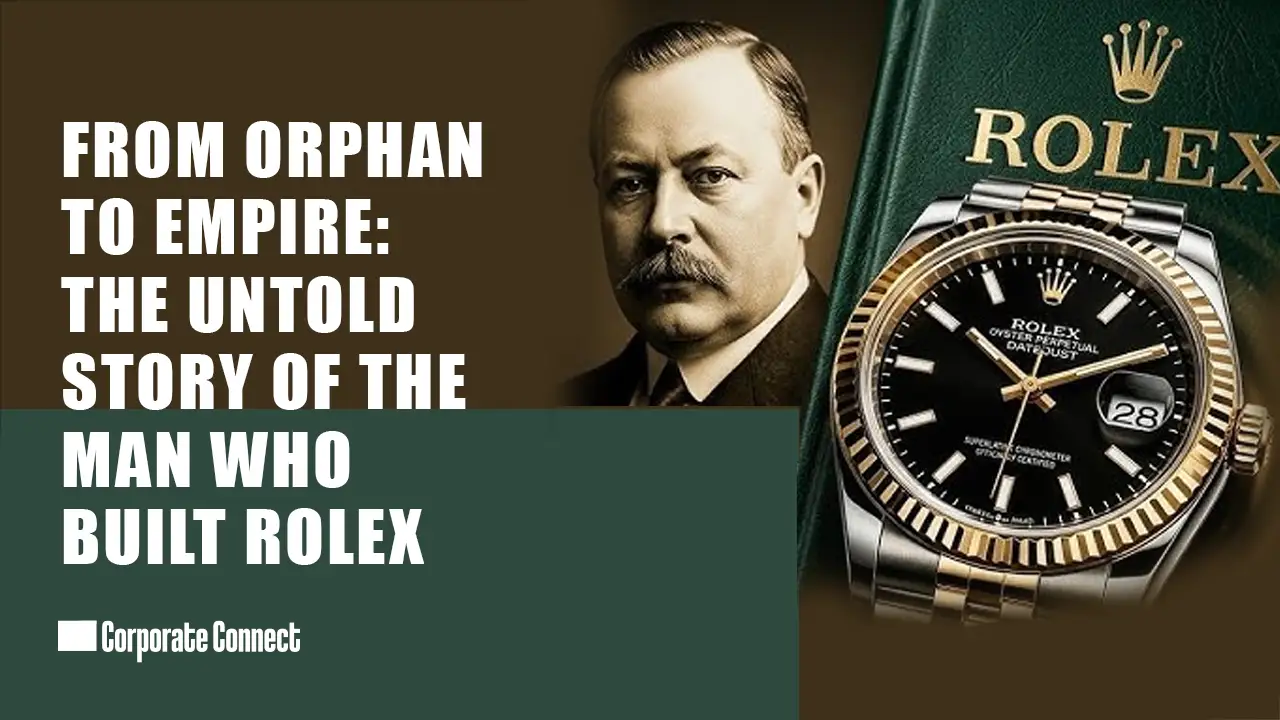
He Lost His Parents at 12, His Business at 30, and His Wife at 60 — Yet He Built the Most Iconic Watch Brand on Earth. This is the Story of Hans Wilsdorf.
There is a watch with a small crown logo on your wrist or on the wrist of someone you look up to. Five points. Golden. Regal. It remains silent as it rests on the dial. However, if that crown could speak, it would tell you one of the most remarkable tales in the annals of human aspiration.
It would recount the story of a boy who lost everything twice and didn’t give up.
The Boy Who Had Nothing
Hans Eberhard Wilhelm Wilsdorf was born in Kulmbach, Bavaria, Germany, on March 22, 1881. His early years were tragic. In his own words: “My father passed away shortly after my mother’s early death. And I was an orphan when I was twelve.
Take a moment to consider that. twelve years of age. Not a mother. No dad. There is no safety net.
His inheritance was placed in a trust that he would not be allowed to access until he was an adult since his relatives were unable or unable to take care of him.
Hans and his siblings were enrolled in a highly regarded boarding school by his uncles. Hans subsequently said: “The way in which they made me become self-reliant very early in life made me acquire the habit of looking after my possessions, and looking back, I believe that it is to this that much of my success is due.”
When parents pass away at that age, the majority of children never fully recover. Instability haunts them as they grow up. However, Hans Wilsdorf took a different approach, turning suffering into meaning.
Wilsdorf had a talent for arithmetic and languages at boarding school, which would come in very handy in the future.
Without realizing it, he was discovering exactly what he would require.
The Young Man Who Saw What Others Couldn’t
Hans did not sit still after school. He traveled. He gained knowledge. He was employed.
He started out as an apprentice at a major pearl exporter company with a global sales network. He gained a worldwide perspective from this, something that education could never provide. He saw the cross-border movement of premium items. He was aware of the production, packaging, and marketing of desire.
Hans Wilsdorf learned about Aegler, a watch movement manufacturer in the neighboring Swiss town of Bienne, during his stay there. Aegler was producing tiny movements with lever escapements, perfect for wristwatches. Hans Wilsdorf believed that wristwatches were the way of the future, despite men’s current contempt for them.
Hans Wilsdorf grinned as he looked to the future during a time when men thought wristwatches were frivolous and feminine.
Later, he said: “My personal opinion is that pocket watches will almost completely disappear and that wristwatches will replace them definitively!”
People thought he was crazy. There were no serious wristwatch wearers. The idea of a man strapping a timepiece to his wrist was considered, in the words of the era, contrary to the very concept of masculinity.
However, Hans had witnessed something that no one else had. He was unable to unsee it once he had seen it.
Building the Dream — London, 1905
Hans Wilsdorf relocated to London, England, in 1903. After that, he teamed up with Alfred James Davis, his brother-in-law, and together they founded Wilsdorf & Davis in 1905. Their company specialised in exporting watches — both pocket and wrist — throughout the British Empire.
They were in their youth. They had high aspirations. Additionally, they were creating something that had never been seen before.
They began bringing Swiss movements to England and fitting them into watch cases while collaborating with Swiss watchmaker Hermann Egler. In order to facilitate their cooperation, they also established an office in Bienne, Switzerland.
Making wristwatches precise, dependable, and respected was Hans’s obsession. He traveled throughout Europe to see watchmakers, stressing them on even the smallest aspects of their work, demanding accuracy when others would settle for “good enough.”
He was not starting a watch business. He was creating a benchmark.
The Name That Changed Everything
The business required a name. “Wilsdorf & Davis” was a partnership name that was too long and too common. Hans required something that could be printed on the tiniest dial, spoken in every language, and remembered in every nation.
He looked around. He tried things. For weeks, he mentally combined letters.
Then it struck him: ROLEX.
Punchy, brief, and available in French, English, German, and Spanish. rolls off the tongue. fits on a watch dial flawlessly.
Due to the high taxes in London following World War I, Hans chose Geneva, Switzerland as the new home for the rapidly expanding Rolex brand in 1919.
It was a brilliant move. The heart of watchmaking was Geneva. Being present was more than just useful; it was a declaration of intent.
War Destroys Everything — Again
World War I broke out just as the business was settling into a rhythm.
Germans began to be despised by the British, and Hans Wilsdorf was clearly German. In 1915, he moved his corporate headquarters from London to Switzerland to avoid the harsh environment and taxes.
His base in London was lost. In Britain, his reputation was damaged. He wasted years trying to establish connections in one of the most significant markets in the world.
A lesser guy would have given up. A lesser guy would have returned to Bavaria with his savings and led a tranquil life.
There was nothing inferior about Hans Wilsdorf.
He relocated to Geneva, reassembled his team, refocused, and returned to his job.
The Invention That Shocked the World
By the middle of the 1920s, Hans was obsessed with the idea of a watch that could withstand water.
Wilsdorf was certain that he would take over the watch industry if he could design a waterproof watch case. Paul Perregaux and Georges Perret, two Swiss watchmakers, submitted an application for a Swiss patent in 1925 for a screwed-stem waterproof mechanism. After studying their designs, Wilsdorf developed a straightforward yet ideal watertight enclosure using a screw-down caseback sealed with a rubber gasket.
The Oyster, the first waterproof wristwatch in history, was unveiled by Rolex in 1926. Its hermetically sealed shell shielded the watch from pressure, moisture, and dust.
However, how can you demonstrate to the world that your watch is actually waterproof? You don’t only run advertisements. You set up a scene.
Mercedes Gleitze, a lady who claimed to be able to swim the 20.5-mile English Channel between France and England, came to Hans’ attention in 1927. She was hauled out after almost freezing to death, yet the Rolex Oyster came out of the water in perfect condition. In response to the exposure, Hans published a historic ad in the London Daily Mail. As a result, Rolex gained international recognition as a revolutionary timepiece.
Just one swim. One commercial. In icy waters, a woman is wearing a watch. The press around the world went crazy.
The Watch That Winds Itself
Hans continued to innovate. The next obvious question he posed was why a watch still needed to be manually wound every day if it could withstand water.
The Oyster Perpetual, the first self-winding watch with a perpetual rotor mechanism, was introduced by Rolex in 1931. The famous five-pointed crown emblem of Rolex was unveiled in the same year.
A watch that wound itself as the wearer’s wrist moved. Not winding. Don’t forget. Never quit. Perfect, endless time.
It was unlike anything the watch world had ever seen.
On Everest, In the Deep, Around the World
Hans Wilsdorf looked for well-known chances to test Rolex timepieces in harsh settings. Rolex Oyster timepieces were worn by the first expedition to fly over Everest in 1933. In his Blue Bird vehicle, driver Sir Malcolm Campbell established a land speed record of more than 300 miles per hour at the Bonneville Salt Flats in Utah while wearing a Rolex.
Under Wilsdorf’s direction, Rolex timepieces traveled the globe on the wrists of pilots, warriors, explorers, and world leaders, as well as to the top of Mount Everest with Sir Edmund Hillary and into the ocean with Jacques Cousteau.
Every mountain. Every ocean. All the records. Every wrist that was important.
Rolex was more than just a timepiece. It has come to represent human achievement at the pinnacle of perseverance
The Greatest Loss — and the Greatest Gift
Hans Wilsdorf lost his cherished wife, Florence, in 1944.
From the start, she had been with him. Through two world wars, London, the orphanage years, and the establishment of an empire. In every way, she was his partner.
Wilsdorf never forgot the anguish of losing his family and the hardships of his early years, even though he had amassed a wealth. He transferred all of his Rolex shares to the Hans Wilsdorf Foundation after his wife died in 1944. The foundation was established to guarantee that the company’s income will be used to fund philanthropic organizations, scientific research, and education for future generations. That charity still owns Rolex privately.
After creating a billion-dollar empire, he gave it all away. Not to investors. to avoid hedge funds. Not to a stock market. To the human race.
The Legacy: What $8 Billion Looks Like When Built on Nothing
Hans Wilsdorf, an orphan who lost everything at a young age, escaped his village, traveled overseas, and decided to follow his passion for watchmaking, is credited with starting the $8 billion market for luxury products. As the inventor of the modern wristwatch, he created a billion-dollar empire and permanently altered the watchmaking industry.
Rolex is more than just a brand these days. It’s a language. Wearing a Rolex is more than just wearing a watch; it’s a signal. A signal that reads, “I worked for this.” This is something I deserve. I persisted.
And Hans Wilsdorf would have desired just that.
The Real Lesson
Most people look at a Rolex and see wealth.
But look closer. Behind that crown — behind every tick of that flawless movement — is the story of a 12-year-old boy with no parents, no money, and no guarantee of anything.
A boy who was told wristwatches were a joke. A boy who watched his business nearly collapse during a world war. A boy who lost the people he loved most.
And still — still — he kept going.
Hans Wilsdorf lived by four values throughout his life: vision, hope for the future, perseverance, and an extraordinary ability to work.
No shortcuts. No shortcuts. No shortcuts.
“Like an oyster, it can remain an unlimited time under water without detriment to its parts.” — Hans Wilsdorf, on the Rolex Oyster
Born: March 22, 1881 | Kulmbach, Germany Died: July 6, 1960 | Geneva, Switzerland Legacy: Eternal