

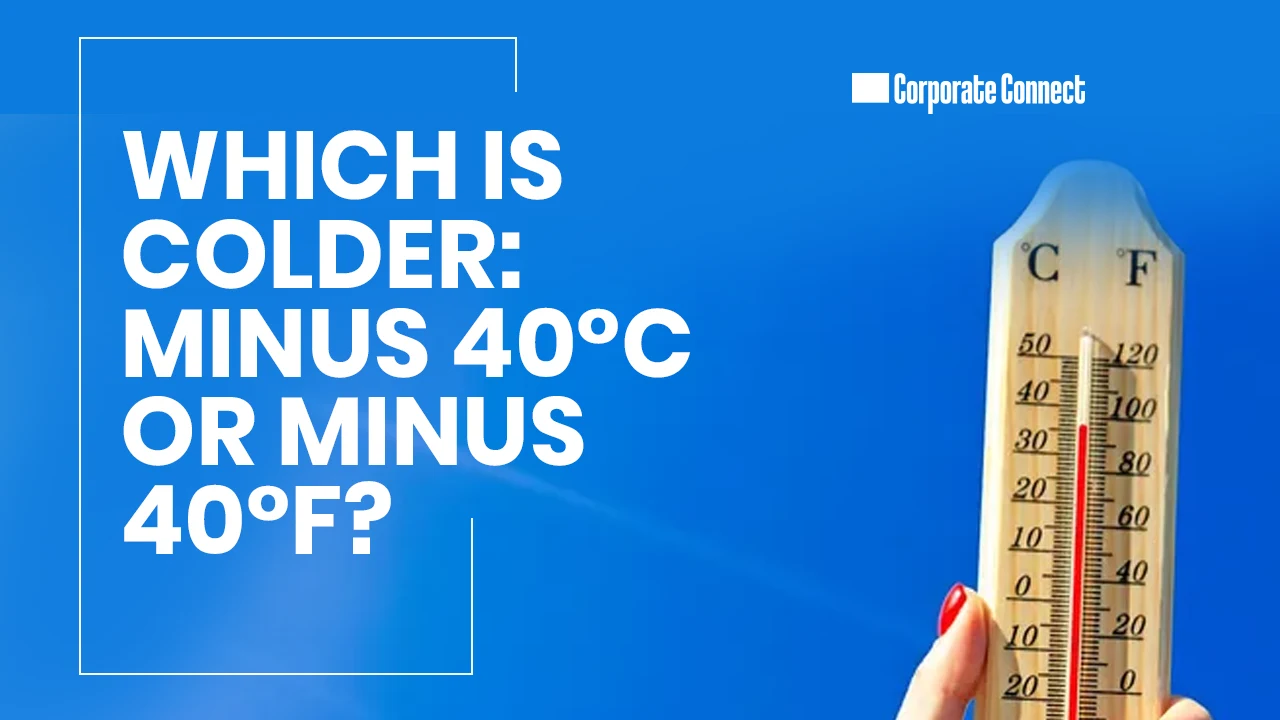
Which Is Colder: -40°C or -40°F
When it comes to extreme temperatures, people often get confused between Celsius (°C) and Fahrenheit (°F). You might have seen signs showing -40° and wondered, “Which is actually colder: -40°C or -40°F?” Let’s break it down.
Which is colder, minus 40°C or minus 40°F? “Googlies” Unlock the Correct Temperature Scale Answer using Google Search Anil Kumble, a cricket player, may be kept awake at night by the temperature scale. Which is colder, minus 40°F or minus 40°C? The correct answer regarding temperature scales can be found with a Google search.
Online searches have undoubtedly become more enjoyable thanks to Google’s Googlies. Particularly after the search engine behemoth featured the renowned cricket players alongside Sourav “Gangoogly” in a quiz campaign, fans were enthralled with the oddball questions. The temperature scale is one of the many questions that might be keeping cricket player Anil Kumble up at night. Which is colder, minus 40°F or minus 40°C? The correct answer regarding temperature scales can be found with a Google search. Since -40° Celsius and -40° Fahrenheit are exactly equivalent, neither of them is colder. The two temperatures are the same. Which nation created Google? Locate the Right Response.
Understanding Celsius and Fahrenheit
-
Celsius (°C) is commonly used worldwide and is based on the freezing (0°C) and boiling (100°C) points of water.
-
Fahrenheit (°F) is primarily used in the United States. It sets water’s freezing point at 32°F and boiling point at 212°F.
The Temperature Conversion Formula
To compare the two scales, we can convert Fahrenheit to Celsius using this formula:
°C=(°F−32)×59°C = (°F – 32) × \frac{5}{9}
Similarly, Celsius can be converted to Fahrenheit using:
°F=(°C×95)+32°F = (°C × \frac{9}{5}) + 32
Comparing -40°C and -40°F
Let’s do the math:
−40°F→°C=(−40−32)×59=−72×59=−40°C-40°F → °C = (-40 – 32) × \frac{5}{9} = -72 × \frac{5}{9} = -40°C
Surprisingly, -40°C is exactly equal to -40°F.
Why This Happens
-
The scales intersect at -40.
-
At this point, the numerical value is the same, although the scales are different.
-
This is a rare and unique point in the Celsius and Fahrenheit temperature relationship.
Practical Understanding
-
-40°C / -40°F is extremely cold. For reference:
-
Water freezes at 0°C (32°F)
-
Typical winter temperatures in Siberia or Alaska can reach -40°C / -40°F.
-
-
Both temperatures are dangerous for humans, potentially causing frostbite in minutes if exposed without protection.
Fun Fact
Because -40°C equals -40°F, scientists and meteorologists often point to this as a unique crossover temperature between the two scales.
Conclusion
So, which is colder: -40°C or -40°F? The answer is simple: neither—they are the same temperature. It’s a fascinating example of how measurement systems can sometimes intersect in surprising ways!
FAQ: Which Is Colder: -40°C or -40°F?
1. What is the difference between Celsius and Fahrenheit?
-
Celsius (°C) is based on water’s freezing (0°C) and boiling points (100°C) and is widely used globally.
-
Fahrenheit (°F) is mainly used in the U.S., with water freezing at 32°F and boiling at 212°F.
2. How can I convert Fahrenheit to Celsius?
Use the formula:
°C=(°F−32)×59°C = (°F – 32) × \frac{5}{9}
3. How can I convert Celsius to Fahrenheit?
Use the formula:
°F=(°C×95)+32°F = (°C × \frac{9}{5}) + 32
4. Which is colder: -40°C or -40°F?
Surprisingly, -40°C is exactly equal to -40°F. This is the point where the two scales intersect.
5. Why do -40°C and -40°F equal each other?
The two temperature scales cross over at this point, meaning the numerical value is the same despite the different scales. It’s a rare and unique intersection.
6. How cold is -40°C / -40°F in practical terms?
-
Extremely cold and potentially dangerous for humans.
-
Water freezes at 0°C (32°F).
-
Temperatures in Siberia or Alaska can reach -40°C / -40°F.
-
Frostbite can occur in minutes without protection.
7. Is there any scientific significance to this temperature?
Yes, scientists and meteorologists often highlight -40 as a unique crossover temperature between Celsius and Fahrenheit.
8. Can -40°C / -40°F occur in everyday weather?
Yes, though it’s extremely rare. Such temperatures are typically found in extreme cold regions, like parts of Siberia, Alaska, or Antarctica.
9. How should humans protect themselves at -40°C / -40°F?
-
Wear insulated clothing, gloves, and face protection.
-
Limit exposure outdoors.
-
Avoid direct contact with exposed skin to prevent frostbite.
10. What’s the takeaway about -40°C and -40°F?
Neither is colder than the other—they are exactly the same temperature, showing how Celsius and Fahrenheit scales can intersect in a fascinating way.
11. How does -40°C / -40°F compare to everyday cold temperatures?
-
A typical winter day in New York or London is around -5°C to 5°C (23°F–41°F).
-
-40°C / -40°F is far colder than most people will experience, highlighting extreme conditions.
12. Can water exist as liquid at -40°C / -40°F?
No. At -40°C / -40°F, water is completely frozen. Only specialized liquids with antifreeze properties can remain liquid at these temperatures.
13. Why do people often confuse Celsius and Fahrenheit at very low temperatures?
The scales have different zero points and increments, making it hard to intuitively estimate extreme temperatures without conversion formulas.
14. Are there other temperatures where Celsius and Fahrenheit have the same number?
No, -40°C / -40°F is the only temperature where the numbers are equal on both scales.
15. How does -40°C / -40°F affect everyday objects?
-
Rubber and plastic can become brittle.
-
Batteries may lose power quickly.
-
Vehicles may require special antifreeze and winterization to function.
16. Can humans survive at -40°C / -40°F without protection?
Survival without protective clothing is extremely dangerous. Frostbite and hypothermia can occur in minutes, depending on wind and exposure.
17. Is -40°F common in the United States?
-
Only in extreme northern regions, such as Alaska, during the coldest winter months.
-
Most of the U.S. rarely experiences such low temperatures.
18. How is -40°C / -40°F used in science or engineering?
-
Often used as a reference point for studying extreme cold.
-
Engineers test materials and electronics at -40 to ensure functionality in harsh climates.
19. Can animals survive at -40°C / -40°F?
Some animals, like Arctic foxes and polar bears, are adapted to survive extreme cold, but most wildlife would struggle without shelter or hibernation.
20. What is the wind chill effect at -40°C / -40°F?
Wind can make it feel even colder, dramatically increasing the risk of frostbite and hypothermia. For example, a strong wind can make -40 feel like -55°C / -67°F.