

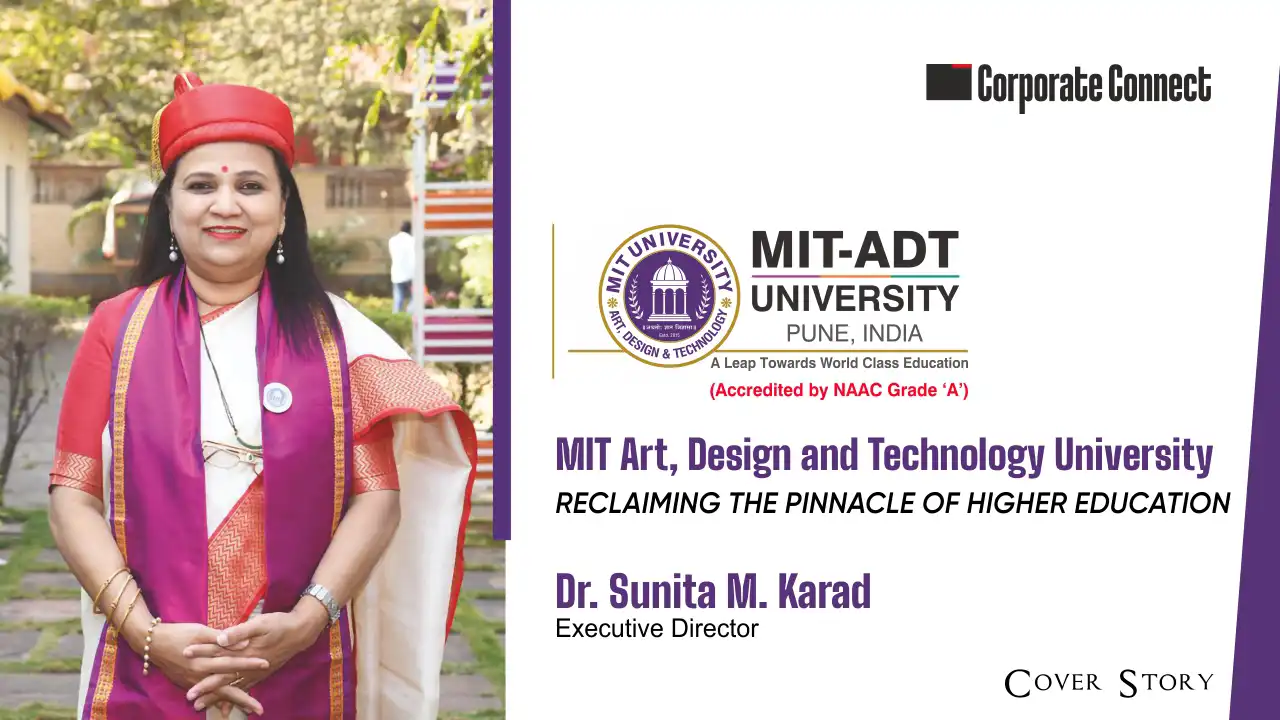
Set against the serene and contemplative landscape of Rajbaug, Loni Kalbhor in Pune, along the historic Solapur Highway, MIT Art, Design and Technology University stands as a distinguished emblem of India’s progressive educational renaissance. The campus environment—calm yet intellectually vibrant—beautifully mirrors the institution’s philosophy that education must nurture reflection as much as ambition.
More than a conventional center of academic instruction, the University represents a thoughtfully envisioned confluence of knowledge, creativity, technological advancement, and ethical responsibility. Here, education is not merely delivered; it is cultivated as a lifelong pursuit of excellence, wisdom, and meaningful contribution.
Established in 2015 under the Government of Maharashtra Act, MIT ADT University emerged at a transformative moment in India’s higher education journey. As the nation increasingly sought institutions capable of transcending disciplinary silos and fostering holistic intellectual development, the University responded with clarity of vision and unwavering purpose.
Rooted in the illustrious legacy of the MIT Group of Institutions, the University draws profound inspiration from its Founder, Prof. Dr. Vishwanath D. Karad, whose lifelong mission has been to harmonize Science, Spirituality, and Service. This philosophical foundation continues to shape the University’s identity, ensuring that academic rigor is always complemented by ethical grounding and humanistic values.
At the heart of the University’s evolution lies its guiding principle, “Leadership through Knowledge.” This philosophy reflects the deep conviction that authentic leadership arises from intellectual depth, moral courage, and social consciousness. Under the visionary stewardship of Prof. Dr. Mangesh T. Karad, Executive President & Pro-Chancellor, and the empathetic yet strategically driven leadership of Dr. Sunita Karad, Executive Director, the institution has steadily matured into a vibrant multidisciplinary ecosystem.
Their collective leadership harmonizes academic discipline with creative freedom, innovation with inclusivity, and ambition with responsibility. This balanced approach has enabled the University to grow not merely in scale but in depth and distinction.
Today, MIT ADT University encompasses 18 diverse Schools supported by an accomplished academic community of over 1,200 faculty members and a dynamic student population exceeding 15,000 learners. Its expansive academic portfolio spans engineering, management, architecture, design, fine arts, performing arts, film studies, journalism, liberal arts, law, commerce, life sciences, Vedic sciences, marine engineering, and emerging technology domains.
This wide academic architecture encourages interdisciplinary dialogue and collaborative exploration. Students are empowered to move beyond traditional academic boundaries, cultivating a global, solution-oriented mindset that prepares them to address complex and interconnected challenges of the modern world.
A defining hallmark of the University is its unwavering commitment to academic quality and institutional excellence. This commitment has been formally recognized through its ‘A’ Grade accreditation by the National Assessment and Accreditation Council. This distinction reflects robust governance systems, outcome-based education frameworks, strong research orientation, and comprehensive studentcentric practices.
Accreditation, for the University, is not merely a certification of standards achieved, but a testament to its culture of accountability, continuous improvement, and sustainable academic advancement.
Education at MIT ADT University is deliberately designed to extend far beyond classroom pedagogy. The institution embraces an experiential and industry-integrated learning model that prioritizes practical engagement alongside theoretical mastery. Through project-based learning, immersive internships, live industry assignments, studio practice, field research, and collaborative academic initiatives, students gain hands-on exposure that strengthens both competence and confidence.
Active engagement with hundreds of corporate and industry partners ensures that learners encounter real-world challenges, professional standards, and leadership scenarios early in their academic journey. This integrated model ensures that graduates emerge not only academically proficient but professionally adaptable and globally competitive.
Innovation forms another cornerstone of the University’s identity. Research and creative inquiry constitute the intellectual backbone of its academic mission. MIT ADT University actively promotes interdisciplinary research that addresses pressing societal and technological concerns.
Flagship initiatives such as Smart Village Development Programs, autonomous and electric mobility research, drone and aerospace innovation laboratories, renewable energy systems, sustainable urban planning, and digital transformation studies exemplify the institution’s commitment to responsible innovation. These initiatives are grounded in the belief that research must transcend theoretical exploration and generate tangible, measurable societal impact.
The University’s innovation ecosystem is further strengthened through incubation support and entrepreneurial mentoring. By fostering a culture that encourages students and faculty to transform ideas into viable solutions and enterprises, the institution nurtures an entrepreneurial mindset that aligns creativity with societal relevance. Research outputs, patents, publications, and start-up initiatives reflect the University’s growing contribution to India’s knowledge economy
In an era defined by rapid digital transformation, MIT ADT University continues to demonstrate foresight and adaptability. Advanced AI-enabled learning environments, augmented and virtual reality laboratories, digital content studios, and technologydriven academic management systems collectively redefine the contemporary teaching-learning experience.
The integration of technology is treated not as an end in itself but as a strategic enabler of personalized, immersive, and globally connected education. By embedding digital fluency across disciplines, the University ensures that its students are equipped to navigate and shape the evolving global knowledge economy.
Yet, amid these technological advancements, the institution remains steadfast in its human-centric philosophy. Education is envisioned as a transformative force that must ultimately serve humanity. Initiatives focused on rural digitization, women empowerment, environmental sustainability, and community engagement reflect a deep institutional conviction that progress must be inclusive and compassionate.
Students are encouraged to participate in outreach programs and socially responsive innovation projects, reinforcing the integration of professional excellence with civic responsibility.
The cultural vibrancy of the campus further enriches its academic environment. Through festivals, conferences, symposiums, art exhibitions, performing arts showcases, and interdisciplinary forums, students engage in creative expression and intellectual discourse. Such platforms nurture leadership, collaboration, and critical thinking while celebrating diversity of thought and talent.
The campus becomes a living laboratory of ideas where tradition and modernity coexist in dynamic harmony, reflecting India’s rich cultural heritage alongside contemporary innovation.
Global engagement constitutes another important pillar of the University’s strategic vision. Through academic partnerships, exchange programs, collaborative research initiatives, and international conferences, MIT ADT University actively fosters crosscultural dialogue and global exposure. Students and faculty benefit from international perspectives that broaden intellectual horizons and strengthen academic networks.
This global orientation ensures that while the University remains deeply rooted in Indian philosophical values, it remains confidently aligned with international standards and aspirations.
Extending its academic reach beyond geographical and temporal boundaries, the Centre for Distance and Online Education (CDOE) plays a transformative role in democratizing access to quality higher education. Through flexible, digitally enabled programs aligned with global benchmarks, the Centre empowers working professionals, rural learners, and international students.
By bridging physical and socio-economic barriers, CDOE reinforces the University’s enduring commitment to inclusivity, lifelong learning, and equitable educational opportunity.
Sustainability is deeply embedded within the institutional ethos. Green campus initiatives, renewable energy integration, water conservation measures, and environmentally responsible infrastructure reflect the University’s dedication to ecological stewardship.
Academic programs incorporate sustainability frameworks that encourage students to design solutions balancing economic growth with environmental preservation. In nurturing environmentally conscious leaders, the University contributes meaningfully to addressing global climate challenges.
Central to the University’s narrative is its unwavering moral compass. As articulated by Dr. Sunita Karad, “Knowledge provides strength, but wisdom provides direction. Education finds its highest purpose when both are nurtured together.” This guiding philosophy captures the essence of MIT ADT University’s mission. It underscores the distinction between information and insight, competence and conscience, success and significance. It affirms that education must empower individuals not only to excel but also to lead with integrity, empathy, and purpose.
As the institution continues to evolve, it remains anchored in its foundational ideals while embracing future possibilities. Strategic expansion of research centers, continued investment in advanced laboratories, strengthened industry alliances, and deeper global partnerships form part of its forward-looking roadmap. Growth is pursued thoughtfully and responsibly, ensuring that every advancement aligns with the University’s core values and long-term vision.
Today, MIT Art, Design and Technology University stands not merely as an academic institution but as a transformative movement within India’s higher education landscape. It represents an ecosystem where intellectual rigor meets creative exploration, technological innovation coexists with ethical reflection, and leadership is cultivated through knowledge and service. The University’s journey is defined by quiet confidence, steady progress, and enduring resolve.
In shaping generations of learners, MIT ADT University prepares individuals not only for professional achievement but for meaningful societal leadership. Its graduates carry forward an integrated vision of science, spirituality, and service—equipped to innovate responsibly, think critically, and act compassionately. As it advances into the future, the University continues to embody a singular conviction: that the highest purpose of education is not merely success, but lasting significance.