
-by Jaya Pathak
When an institution is with the disease Ebola, there’s a whole lot of difference between people’s confidence and their capacity. The world is better prepared than about a decade ago for the challenges and hardships of the coming decade on paper.
Governments have playbooks for the pandemic, companies make risk dashboards, airports know how to hold people aside for screening and investors master how to price geopolitical risk with chilling rapidity in an accelerating fashion. However, a new virus in a weak health care system can cause a re-evaluation of how much of what is considered to be “modern preparedness” rests on untested assumptions.
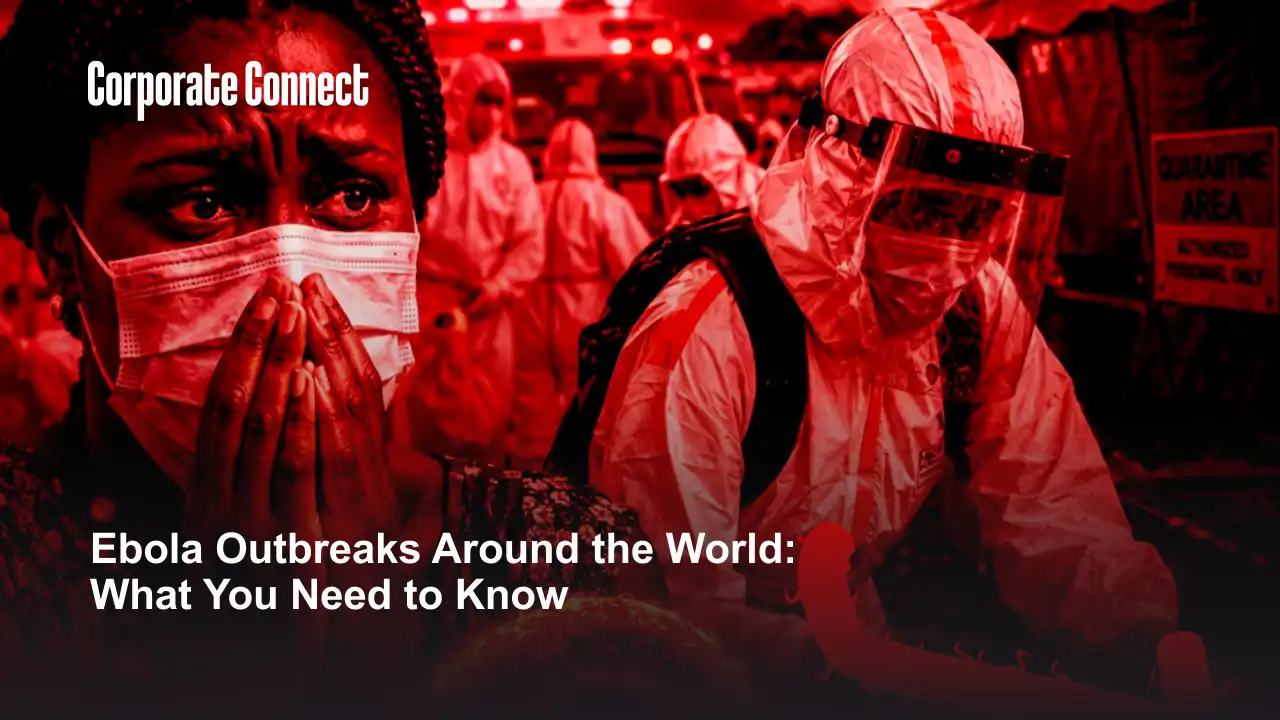
It should be remembered in that context the recent Ebola outbreak in the Democratic Republic of the Congo (DRC) and Uganda, which has been triggered by the Ebola Bundibugyo virus. There is no need for world-wide alarm. Public-health officials in the United States have deemed the Ebola threat to be low here and Ebola itself is far from a spreading airborne respiratory illness.
That distinction matters. While low risk to distant households does not mean low risk to supply chains, regional economies, health workers, humanitarian actors, insurers, or airlines or other companies at risk in African markets, it’s important to note these differences. This difference is generally discovered in business when it’s too late.
When the WHO declared a declared Public Health Emergency of International Concern in May 2026, it was no accident. It was a warning regarding the conditions of operation: insecurity, crossing what are basically permeable borders, challenging capacity for treatment, and the inconvoked fact that there is no specially approved vaccine or treatment for Bundibugyo virus disease.
The latter point is one on which boards typically do not discuss enough. Armed with knowledge and advances in science offered by one Ebola species does not necessarily make oneself prepared for another. Generally, the market believes that once there has been innovation, it can be generalised. Biology isn’t as helpful.
An outbreak is a repetition of some of the situations and only the towns’ names change. A clinic sees a patient who has a fever, weakness and bleeding or has symptoms that could apply to 6 other diseases. Staff makes an effort over what they will. The ambulances are transporting families between the home, the clinic and the cemetery.
When the laboratory tells you that it is not true, then the rumours are. When you hear about the outbreak of cases in the outside world, there are all kinds of other people who have spread the virus — through people who take care of you, drivers, nurses, neighbours, mourners. When borders and balance-sheets are called into question, the business media becomes involved.
The truth is that there is a lot that happens, but the wet-behind-the-ears healthcare systems we have in developed countries don’t always exist in developing countries.
But Ebola was not so clean having been a health sector affair, but rather an epicenter outbreak of the West Africa epidemic should have put it to bed in 2014-2016. The economic damage in Guinea, Liberia and Sierra Leone was severely felt, too, as well as the human damage. The growth forecast was lowered. Fiscal positions deteriorated.
The agriculture, mining, transport, tourism and commerce sectors suffered the brunt of the impact of the disaster long after the initial crisis was over. The World Bank, at the time reporting losses of the region’s multibillion dollar economy in the event of adverse situations. A small proportion of the damage was due to infection. A lot of this was fear; as well as slow on the uptake and how easily distrust can go into the machine and destroy an economy.
That’s where investors get it wrong with respect to the risk of epidemics. They search for numbers, which are the key. He also advises them to check out institutional velocity.
How does it take to complete tests on those suspected? If not, are there any internal or external systems in place to keep them informed? Have staff and supplies of treatment centres? Is there a process of negotiations with the communities about the burial practices or are they imposed?
Is it possible to convey information from village to district to the National authorities without fear and distortion of the information by politics? These questions seem an administrative, even seemingly trivial, type of question. They truly are a matter of keeping it contained or suffering the effects of a regional economic shock.
Following (Covid-19) there was a vogue of talking about resilience. Resilience was becoming a buzzword after Covid-19. The notion of ‘now’ is so commonplace that it has found its way into to new reportage every year, much like ‘innovation’ was a generation ago.
Ebola, though, puts those who must enforce limits on state-sponsored killings to the less conspicuous test of resilience; maintaining supplies of protective clothing, health workers earning their living, laboratories operating and field workers safe while the cameras are not rolling — even if surveillance efforts are not as sophisticated or flattering as they could be.
NEITHER EXECUTIVE IS GLOUDED FOR INVESTING IN A SURVEILLANCE SYSTEM BY STAYING OUT OF THE “BREAKTHROUGH.” When a well-run contact-tracing network in operation, no minister cuts any ribbon. People who work in prevention are often mystified about why it isn’t rewarded in politics, and why it’s successful when it appears that nothing has happened.
A danger exists there, though, that comes at a moral level: taking Ebola’s threat down the same size as a corporate-continuity problem. What really suffers is not investors but the first to suffer the impact. They’re nurses, cleaners, drivers, burial teams and families / small traders who lose their lives’ income if one of them moves to a place suspected.
They are the health workers who have to make the decision of what is right and what is safe for themselves. These are communities that have likely heard thoughts and undertones of promises yet less words from those in authority. Without trust, it’s not a serious business of reading Ebola; it’s a doofy face reading. It is infrastructure.
The world of commerce and commerce is much more advanced today when it comes to responding to what’s happening in its midst. It’s not as impressive when it comes to investing against slow developing fragility. Ebola is wondering if companies, governments and multilateral institutions could finance health security as an ongoing infrastructure investment as opposed to a wait-for-crisis, spend as incident investment.
So far, there is no one definite correct answer. There are better laboratories, faster sequencing, better protocols and a wealth of field experience gained. Exhausted health systems and weak donor commitments, conflict zones and incentives on the commercial side – there’s more that only comes too late.
Being neither alarmed nor indifferent to the situation is a sensible posturing. Ebola is not in the position of being able to paralyze the global economy in the same way as Covid-19 did, as this asset is not so critical. This comparison is not sound, and is not beneficial to the business.
However, it can disrupt locations, condemn already fragile economies, disrupt business operations and bring into the spotlight of attention the vacuousness of preparedness assertions. A senior leader would be well advised to take the message of the lesson home, which is simple: Resilience doesn’t just happen in an organisation when the crisis occurs. That’s when it still performs when the next guy starts in an area out of the market eye.
Ebola will return – subspecies would be its new form – ecology interlocked and mobility and institutional weakness remain in the picture. The key question is: can the world afford patience – of waiting for laboratories before headlines, of trusting in the goodness of others before panic, of having today’s field capacity before emergency declarations or of investing in science ahead of a clearly perceived demand.
Businesses rely on modern risk management techniques that are practiced with ease to cope with probabilities. The capacity, not probability, is the rule of thumb, when it comes to ultimate cost, and Ebola is a reminder of this.