
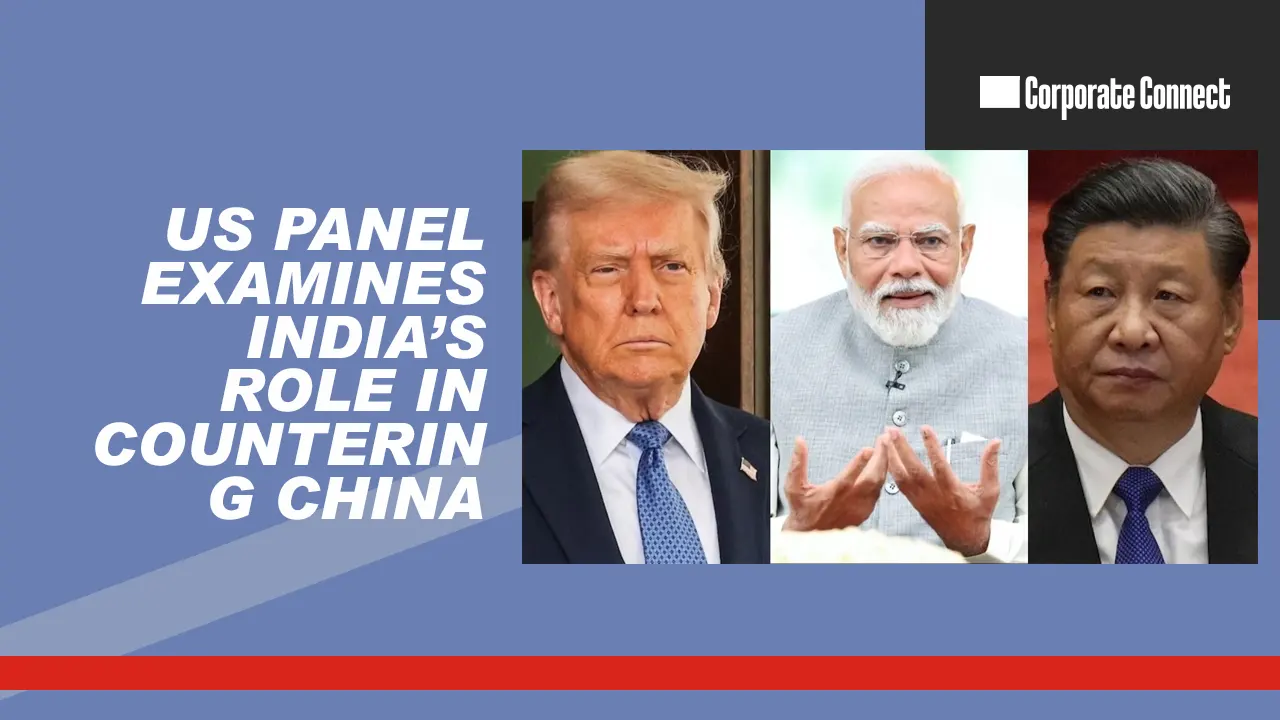
Next month, on February 17, the US-China Economic and Security Review Commission will have its first public meeting for the 2026 reporting cycle. India’s increasing role as an Indo-Pacific security actor, maritime access and rivalry in the Indian Ocean, border issues with China, and other geopolitical and military problems affecting India’s relations with the US and China will be the main topics of debate throughout the hearing.
Prime Minister Narendra Modi’s first visit to Beijing in over seven years, the reopening of air links that had been suspended for five years, and actions by New Delhi to permit Chinese companies to reenter Indian investment and government procurement channels following the Galwan standoff are all examples of what officials describe as a calibrated easing of India’s posture toward China.
Commissioners will also examine the economic and technological facets of India-China relations, highlighting trade and investment connections as well as India’s efforts to become independent in vital and developing industries like semiconductors, artificial intelligence, and pharmaceutical supply chains, which Washington believes are essential to long-term strategic competition with Beijing.
Beyond the dynamics between Beijing and New Delhi, the Commission will examine US policy initiatives to fortify its strategic alliance with India and evaluate the Possible impact of India’s engagement with China on critical US national security and economic interests in the coming years.
The hearing’s importance is increased by its timing. As the US-China rivalry grows more intense, major nations are reviewing alliances and economic plans as part of a larger global geopolitical upheaval. As a crucial Indo-Pacific counterweight to China, Washington has made political, military, and economic investments in India during the last ten years. India is at the center of US efforts to curb Beijing’s influence throughout Asia due to its size, strategic position, and developing military capabilities.
STRATEGIC IMPLICATIONS FOR US-INDIA TIES
But throughout the past year, from January 2025 to January 2026, tensions between Washington and New Delhi have been evident, making attempts to strengthen strategic coordination more difficult. The question of how firmly India can be rooted in an American-led security framework while maintaining its own strategic autonomy and managing ties with China has been raised by these tensions in US policy circles.
The hearing also occurs only six weeks prior to President Donald Trump’s planned state visit to China in April 2026, highlighting the careful diplomatic balancing act that Washington is performing as it considers deterrence, rivalry, and engagement with Beijing.
Congress created the US-China Economic and Security Review Commission in 2000 as part of the National Defence Authorization Act. The commission’s annual mandate is to examine, evaluate, and report on “the national security implications of the economic relationship between the United States and the People’s Republic of China.” Its findings are extensively monitored on Capitol Hill and frequently influence congressional discussions about trade, technological limitations, and China-related security policy.
US TO COUNTER CHINA IN THE INDIAN OCEAN
The commission recommended in 2022 that the US Congress order the US Secretary of State, US Secretary of Defense, and USAID Administrator to present a strategy on US interests in the Indian Ocean region that takes China’s rivalry into account. This strategy should include:
- Promoting regional growth and US economic activity;
- Defending the right to travel freely;
- Helping and backing partners and allies in the region in resolving security issues;
- Promoting collaboration with major defense partners like India, NATO allies like the UK and France, and US allies in the Indo-Pacific, such Japan and Australia, to preserve a rules-based order in the area.
The hearing will be co-chaired by Commissioner Hal Brands and Commissioner Jonathan N. Stivers. Co-chair Hal Brands is the Henry A. Kissinger Distinguished Professor of Global Affairs at Johns Hopkins University’s School of Advanced International Studies and the senior fellow at the American Enterprise Institute.
Randall Schriver, a former Assistant Secretary of Defense for Indo-Pacific Security Affairs and Chairman of the Board of the Institute for Indo-Pacific Security, is another well-known person connected to the Commission’s work. In order to thwart China’s strategic goals, Schriver, who formerly oversaw Pentagon policy for the area, has been a major proponent of fortifying US ties and relationships across Asia.
As the United States navigates a changing Indo-Pacific landscape, where India’s decisions between innovation, collaboration, and strategic autonomy might alter regional power balances for years to come, lawmakers and officials are likely to closely evaluate the Commission’s conclusions.