

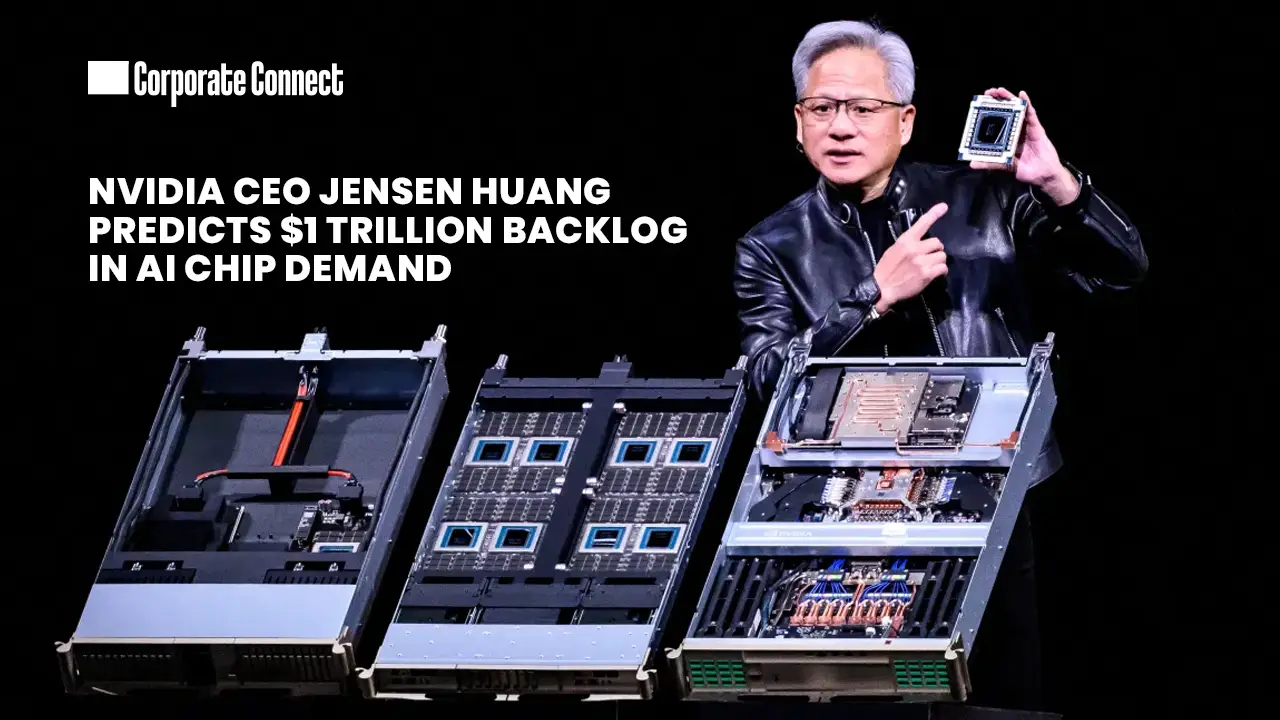
Nvidia CEO Jensen Huang unveiled his strategy for maintaining the company’s leadership in the artificial intelligence sector, projecting a backlog of $1 trillion in orders for the upcoming year.
In a two-hour talk at a crowded San Jose, California venue, Huang highlighted the vital role Nvidia’s processors play in AI technology and talked about the technologies that will maintain the company’s competitive edge.
Huang’s Prospects for the Future of AI
The 63-year-old Huang reaffirmed important points he has made in previous years, stressing that the current stage of AI development is only the beginning. “We reinvented computing, just like the PC and internet revolutions,” he said. A new platform update is now underway.
Projected Growth and Challenges
By year’s end, Huang projected that Nvidia’s order backlog will total $1 trillion, a substantial rise above his earlier projections. Nvidia’s sales increased from $27 billion in 2022 to $216 billion last year, generating in a market valuation of $4.5 trillion, which is consistent with this trend.
Nvidia’s stock has seen turbulence since it briefly exceeded a $5 trillion market value in October of last year, despite this remarkable increase. Following a quarterly report that exceeded expectations, stock prices have dropped by 6% due to concerns about the durability of the AI boom.
Competitive Landscape and Market Dynamics
Nvidia faces growing competition as digital behemoths like Google and Meta Platforms create their own AI processors, despite experts predicting the company’s sales to surpass $330 billion in the upcoming year. Nvidia’s ability to sell cutting-edge processors in China has also been hampered by trade and security limitations in the United States.
Nvidia’s Strategic Initiatives
By addressing the growing need for processors used in applications like chatbots and improving Nvidia’s position in the inference processor market, Huang hopes to consolidate Nvidia’s crucial role in AI. By optimizing the use of taught AI models, inference chips increase response generation efficiency.
As he described Nvidia’s intentions to strengthen its capabilities through a multi-billion dollar license arrangement with Groq, which involves hiring top engineers from the company, Huang said, “The inference inflection has arrived.”
“Nvidia isn’t going to cede any market share to Google or Meta,” said to analyst Dan Ives, who also projected that the company’s market valuation might exceed $6 trillion in the coming year.
FAQs
1. What did Jensen Huang announce about Nvidia’s AI future?
Jensen Huang revealed that Nvidia expects a massive $1 trillion backlog in AI chip orders, highlighting strong future demand in the artificial intelligence sector.
2. Why is Nvidia important in the AI industry?
Nvidia plays a crucial role in AI by producing high-performance GPUs and processors used in machine learning, data centers, and AI applications like chatbots and automation tools.
3. What is meant by Nvidia’s $1 trillion backlog?
The backlog refers to confirmed and expected orders for AI chips, indicating strong demand from tech companies and enterprises planning AI infrastructure investments.
4. How much has Nvidia grown in recent years?
Nvidia saw revenue grow from $27 billion in 2022 to $216 billion, with its market valuation reaching around $4.5 trillion, reflecting the AI boom.
5. What challenges is Nvidia currently facing?
Despite strong growth, Nvidia faces:
-
Increasing competition from Google and Meta Platforms
-
US export restrictions impacting chip sales to China
-
Market concerns about the long-term sustainability of AI demand
6. What is Nvidia’s strategy to stay ahead in AI?
Jensen Huang emphasized:
-
Expanding into AI inference chips
-
Strengthening partnerships and talent acquisition
-
Enhancing efficiency of AI models and computing platforms
7. What are AI inference chips and why are they important?
Inference chips help AI systems generate responses faster and more efficiently after training. This is critical for applications like chatbots, search engines, and real-time AI services.
8. How are companies like Google and Meta competing with Nvidia?
Google and Meta Platforms are developing in-house AI processors, reducing their dependence on Nvidia’s hardware.
9. What impact do US-China trade restrictions have on Nvidia?
Export controls limit Nvidia from selling its most advanced chips to China, affecting a significant market segment.
10. What is the future outlook for Nvidia?
Analysts believe Nvidia could continue its rapid growth, with projections suggesting revenues may exceed $330 billion and valuation could rise further if AI demand remains strong.