

In the area of artificial intelligence, artificial general intelligence, or AGI, has long been seen as the holy grail, something that is just out of reach yet is getting closer every year. The concept of computers with human-like intelligence, reasoning, and adaptability is simple to describe but challenging to implement.
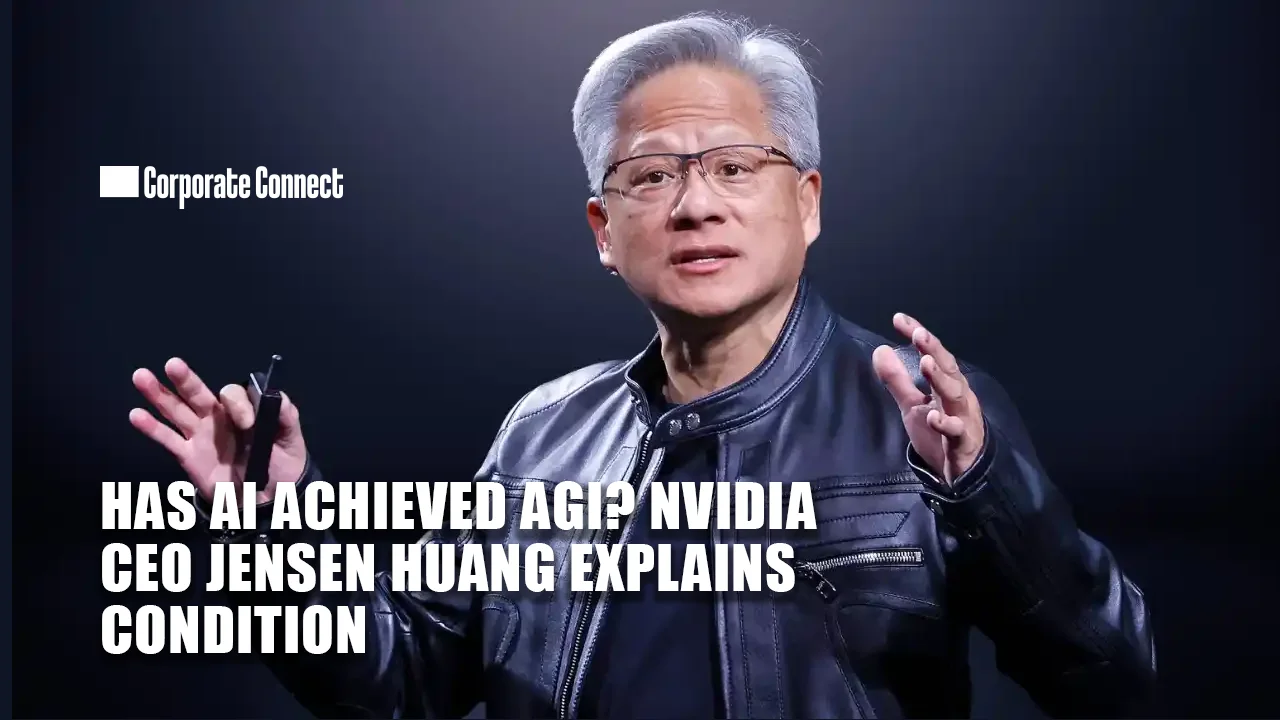
While businesses like OpenAI and xAI are working hard to achieve that objective, Jensen Huang has stirred things up with a somewhat surprising perspective. Depending on how you define AGI, he says we could already be there.
“I think we’ve achieved AGI”
Speaking on the Lex Fridman Podcast, Huang addressed presenter Lex Fridman, who described AGI as an AI that could create and manage a billion-dollar business. Huang didn’t think twice. He stated, “I think it’s now,” implying that under this standard, AGI isn’t some far-off turning point. It has already arrived.
But there’s a nuance. Huang made it apparent that he was in favor of that particular concept rather than the more expansive, ambitious idea of intelligence like to that of humans.
The Startup Analogy and OpenClaw
Huang cited OpenClaw, an open-source framework made to operate AI agents locally, to support his argument. In principle, he contended, such techniques may produce an app or service that unexpectedly draws millions or even billions of users. Think viral apps, quick monetisation, and explosive growth.
It’s not an entirely implausible notion. Huang likened it to the dot-com boom, when the value of websites could soar practically overnight. However, he also recognized the opposite. Many of such achievements were short-lived. They surged and then abruptly subsided.
In partnership with Peter Steinberger, the author of OpenClaw, who has since joined OpenAI, Nvidia even unveiled its own version, NemoClaw.
Why AI Still Can’t Build Nvidia
Huang took a strong stance on long-term, difficult success despite his optimism. He doesn’t think AI agents can mimic Nvidia. It’s a completely other game to build a business that size with consistent innovation and strategy. The likelihood of hundreds of AI bots joining together to create Nvidia is basically negligible, as he stated simply.
The Bigger AGI Debate Continues
There is disagreement within the industry regarding the arrival of AGI. Current AI systems still have trouble with long-term planning and ongoing learning, as Demis Hassabis has noted. True AGI, in his opinion, may still be five to eight years away.
Elon Musk, on the other hand, has set a much more driven schedule, predicting that AGI may be available in the coming years.
So, is AGI a reality or is it still in the future? Who you ask and, more crucially, how you define it will determine that.
FAQs
1. What is Artificial General Intelligence (AGI)?
AGI refers to a type of AI that can think, learn, and adapt like a human, performing a wide range of tasks across different domains without specific training.
2. Has AI already reached AGI?
According to Jensen Huang, AI may have already reached AGI depending on how it is defined, particularly if it can build and manage a billion-dollar business.
3. What condition did Jensen Huang mention for AGI?
Huang suggested that if AGI is defined as AI capable of creating and scaling a billion-dollar company, then current AI systems may already meet that threshold.
4. Why is there debate about AGI?
Experts disagree because AGI lacks a clear universal definition. Some define it as human-level intelligence, while others focus on economic or functional capabilities.
5. What is OpenClaw and its role in AGI discussion?
OpenClaw is an open-source platform for running AI agents locally. Huang cited it as an example of how AI could potentially create viral, high-value applications.
6. Can AI build companies like Nvidia?
No, according to Jensen Huang, AI currently cannot replicate the complexity required to build a company like Nvidia, which requires long-term strategy and innovation.
7. What do other experts say about AGI?
- Demis Hassabis believes AGI is still 5–8 years away
- Elon Musk predicts AGI could arrive within the next few years
8. Why is AGI considered the “holy grail” of AI?
AGI is seen as the ultimate goal because it would enable machines to match or exceed human intelligence, transforming industries, economies, and daily life.
9. What are the limitations of current AI systems?
Current AI still struggles with:
- Long-term planning
- Continuous learning
- General reasoning across tasks
10. Is AGI already here or still in the future?
It depends on the definition. Under narrow, task-based definitions, some believe AGI is already here. However, under broader human-level intelligence definitions, it is still in development.