
Delhi’s most recent framework for slum rehabilitation and resettlement has the potential to change both the urban growth model of the city and the lives of millions of people who dwell in informal settlements.
The Delhi Slum and JJ Cluster Rehabilitation and Relocation Policy, 2026, which was recently authorized, aims to replace piecemeal rehabilitation with a large-scale redevelopment strategy based on public-private partnerships (PPP). In addition to releasing property value to fund redevelopment, the initiative seeks to give eligible residents permanent housing.
The project has the potential to be one of the biggest urban regeneration initiatives in the nation’s capital, given the city’s struggles with growing housing demand, land shortages, and decades of unplanned urbanization.
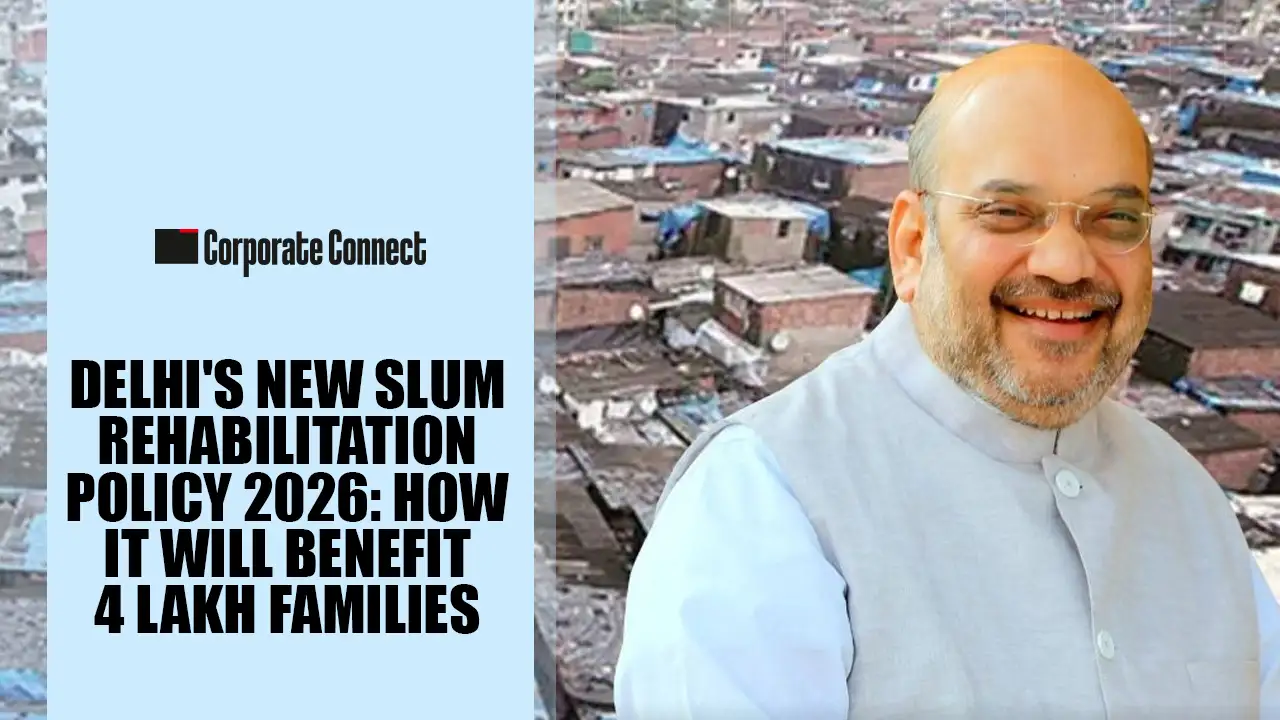
The strategy, which was approved on June 16 at a high-level meeting presided over by Union Home Minister Amit Shah, aims to give an estimated four lakh households residing in JJ (Jhuggi-Jhopri) clusters throughout the city access to permanent homes and civic amenities.
“In the meeting, Union Home Minister Amit Shah said Delhi Slum and JJ Cluster Rehabilitation and Relocation Policy, 2026, has been finalised today and the Government of Delhi should notify it at the earliest,” a government release said.
Why the policy is important
A significant portion of Delhi’s labor force, including domestic workers, truckers, vendors, construction workers, and other service-sector workers, reside in the city’s JJ clusters.
Delhi has 675 recognized JJ clusters, according to DUSIB, while officials believe the true figure may be closer to 750 after taking into consideration settlements that developed after 2015.
The expansion of these communities has long been associated by urban planners with the lack of reasonably priced housing close to employment centers.
Instead of continuing to expand informal settlements, the new policy aims to close that gap through planned reconstruction and rehabilitation.
The PPP concept is crucial to the reconstruction process.
The public-private partnership (PPP) model is a major component of the policy.
Developers will build multi-story housing buildings for qualified slum dwellers within the framework. The expense of restoration will be partially covered by commercial development on a portion of the land.
Every month, the Delhi government intends to release bids for a minimum of five PPP-based rehabilitation projects.
Amit Shah gave the Delhi Development Authority (DDA) and Delhi Urban Shelter Improvement Board (DUSIB) instructions to create project documents and tender forms for an additional 50 clusters and to issue tenders for five JJ clusters within 45 days.
Rehabilitation initiatives are expected to start in clusters in Mayur Vihar, Seelampur, Pitampura, Sultanpuri, and Lajpat Nagar, according to officials.
“Jahan Jhuggi Wahi Makan”
Making ensuring that rehabilitation stays connected to current communities and job centers is one of the policy’s core goals.
The central and Delhi governments are collaborating to provide “Jahan Jhuggi Wahi Makan” (homes where jhuggis are), according to Chief Minister Rekha Gupta.Within the following forty-five days, DDA and DUSIB will start the Phase I tender process for five JJ clusters.
Additionally, the Delhi government would put out bids for at least five PPP-based rehabilitation projects each month. Basic amenities like schools, health centers, playgrounds, and anganwadi centers will be provided in these new colonies, she stated.
Put civic infrastructure first.
The new program places a strong emphasis on social infrastructure, in contrast to previous housing interventions that were mainly concerned with dwelling units.
Amit Shah, the home minister, instructed officials to make sure that community facilities, such as playgrounds in rehabilitation colonies, educational institutions, health centers, and anganwadi centers, are adequately provided.
The strategy is part of a larger change in urban redevelopment policy that goes beyond building homes to include integrated neighborhoods.
Eligibility expanded by a decade
The policy’s extending of the qualifying cut-off date is one of its most important modifications.
Under the current policy, the eligibility date for permanent housing allocation has been shifted from January 1, 2015 to January 1, 2025.
It is anticipated that the action will significantly boost the number of beneficiaries and include a greater proportion of slum dwellers in the rehabilitation program.
Shah further ordered that January 1, 2025, be set as the eligibility deadline for JJ clusters.
The implications for the housing market in Delhi
Beyond rehabilitation, the policy may have consequences.
Redeveloping JJ clusters on a large scale could open up strategically placed land parcels around the city, enhance urban infrastructure, and expand the supply of formal housing near economic hubs.
In developed urban areas where new purchase opportunities are few, the PPP structure provides developers with access to land.
By permitting commercial development to cross-subsidize restoration expenses, the approach aims to strike a compromise between social housing goals and financial sustainability for the government.Pucca dwellings would be provided to all slum inhabitants.
When their family’s living situations are improved, Gen-Zs would have a better future, Delhi’s urban development minister Ashish Sood said TOI.
The policy’s effectiveness will ultimately depend on its implementation, funding, and capacity to provide housing and related infrastructure on a large scale. Plans are being developed for the progressive rehabilitation of at least 50 additional JJ clusters.