
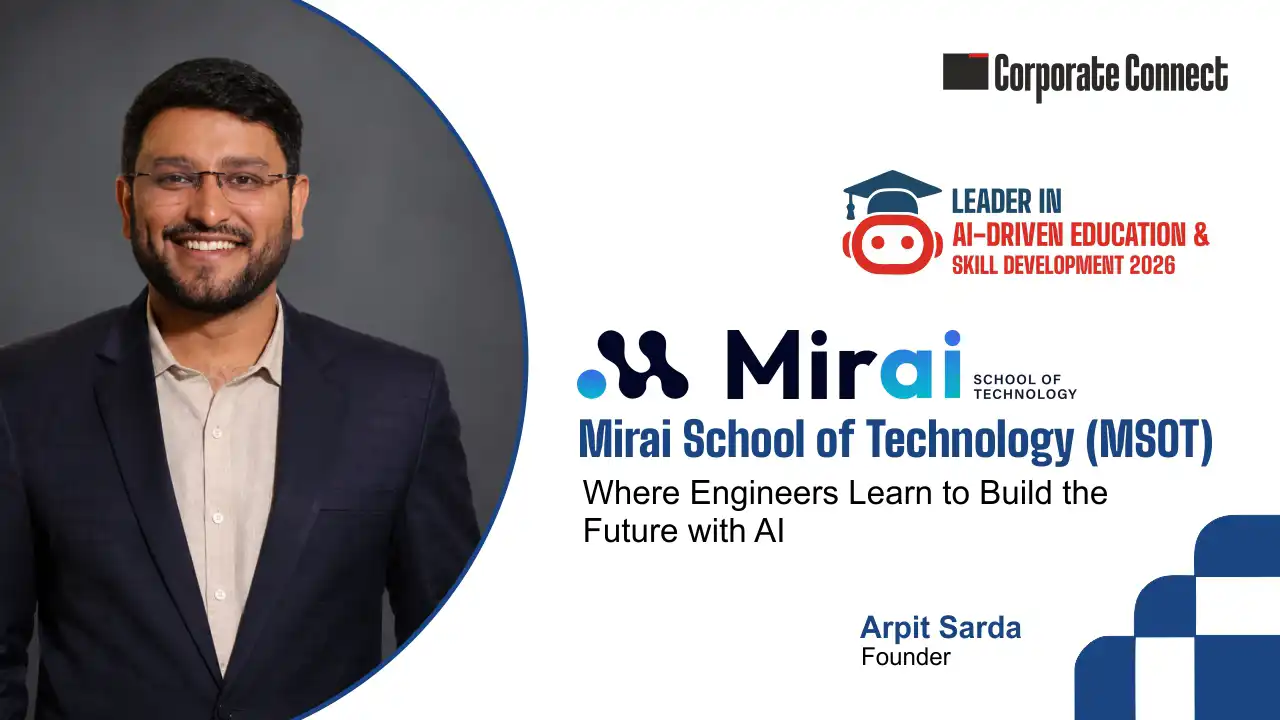
Mirai School of Technology (MSOT) is India’s next generation AI-first new age program, founded in 2025 with one clear goal: to give engineering students the real skills, the right mindset, and the career readiness that the industry actually wants.
The name “Mirai” means “future” in Japanese, and that one word says everything about how the program is built. MSOT offers a four-year B.Tech in Computer Science Engineering with an AI specialisation, across AICTE-approved campuses in Ghaziabad, Bengaluru, and Jaipur, with a UGC-approved university degree.
From Day 1, students write real code and build real AI projects using tools like GitHub Copilot, ChatGPT APIs, and Google Cloud. The environment is AI-focused and tech-led, with facilities, faculty, and a curriculum built to make students job-ready before they even graduate. By the time they finish, they have a portfolio of 30+ real-world projects, 8+ industry certifications, and experience with 15+ AI tools. Admission is selective. Only the top 12% of applicants clear the MAINS entrance test and interview, keeping every batch at a high standard.
MSOT is growing fast too. They recently launched their newest campus in Jaipur at Jagannath University, adding to their existing campuses in Ghaziabad and Bengaluru. You can explore everything at miraisot.com.
From Finance to Founding
Founder Arpit Sarda did not come from a typical education background. A BITS Pilani CS graduate and IIM Kozhikode MBA, he worked as a Chief Minister’s Fellow and Manager of Planning and Strategy at the Debt Management Office, Government of Maharashtra, before taking on senior roles at Cars24 and Awfis Space Solutions.
In every one of these jobs, he kept seeing the same thing. Talented engineers were coming out of college without the skills to actually do the work. It was not a small gap. It was a deep, structural problem that nobody was fixing. MSOT was his answer to that, built not around what looks good on paper, but around what companies actually need from the people they hire.
The Biggest Challenge: Making People Believe
The hardest part was not building the program. It was getting people to trust it. In India, families pick colleges based on names they have known for decades. A new program, no matter how good, does not have that. It has to earn it.
MSOT did that by being completely open. The curriculum was made public. Real students talked about their experience honestly. And instead of bringing in career academics, MSOT hired working engineers as faculty, people still active in the industry, teaching from real experience. On top of that, MSOT got verified by B2K, an independent firm, so students and families did not just have to take their word for it.
What Students Actually Learn
At MSOT, AI is not one subject among many. It runs through all four years. By Year 3, students are building LLMs, learning prompt engineering, and studying neural networks. Cloud platforms like GCP, Azure, and AWS come in from Year 1. Blockchain projects are tackled in Year 3. The Sentient Robotics Lab brings AI and hardware together. AR and VR are part of the experience through the MiraiVerse Lab.
And the curriculum does not sit still. MSOT updates what it teaches based on what the industry is asking for right now, not what was relevant a year ago.
A Culture Built on Ownership
MSOT runs on a flat structure where everyone is expected to speak up, take ownership, and get things done. Results matter more than just being busy. Mistakes are treated as lessons. Growth is expected from students and staff equally.
The belief behind all of it is simple. The best engineers are not just good with code. They are accountable, curious, and can work without someone holding their hand.
Milestones That Actually Matter
Arpit does not get too excited about press coverage. What he actually tracks is what students are achieving.
From the very first batch, Shree Adya ranked in the Top 50 globally in Google’s The Big Code 2026. Tanu Saini and Padmasri Chikle cracked GirlScript Summer of Code. Three national wins from one batch, in their first year itself. MSOT was also covered in Financial Express, Economic Times, ANI, India Today, and Zee News within its first year, and launched successfully across three cities.
But the milestone he is really waiting for is MSOT’s first batch entering the workforce. That, he says, is when you find out if everything you built actually worked.
Advice to Education Entrepreneurs
Arpit’s advice is straightforward. Start with the problem, not the idea. Most people get excited about a concept, run with it, and only realise later they were building something for themselves rather than for the people who actually needed it. When you build because a real gap exists, everything changes. You make better decisions, you listen more, and you stop chasing things that only look good from the outside. That, he believes, is the difference between a program that lasts and one that just launches.