

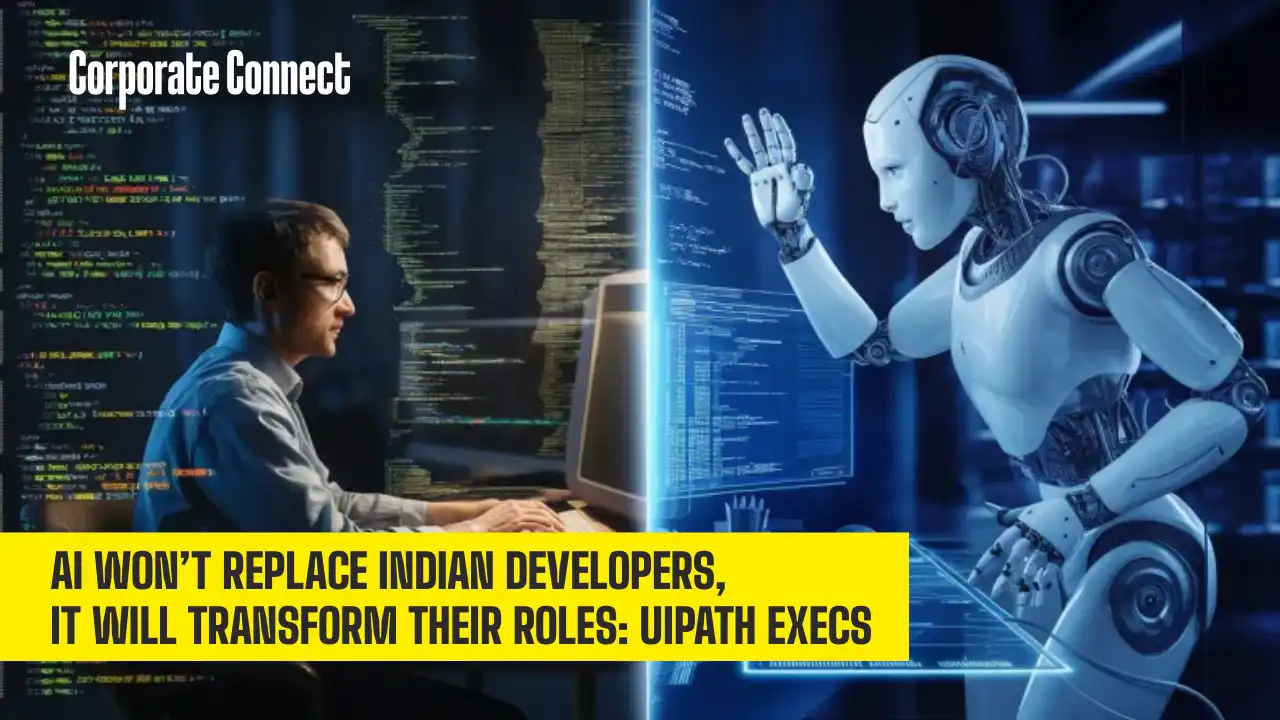
Senior executives at enterprise automation company UiPath have refuted concerns that artificial intelligence (AI) could replace India’s sizable developer workforce, claiming that coding bots will increase rather than decrease demand for programmers even as they transform positions across the industry.
Speaking at UiPath DevCon Bengaluru 2026, South Asia Area Vice President DebDeep Sengupta and BW Businessworld Chief Technology and Product Officer Raghu Malpani stated that AI agents were boosting software output and problem-solving capability, doubling India’s significance as a long-term engineering hub despite a wider global reorganization of the tech industry.
Jevons Paradox, Not Job Loss
Malpani explained the impact using the widely debated “Jevons Paradox,” which states that increased productivity from coding bots results in the need for more engineers and more software.
“The question of whether we still need as many engineers arose naturally once we started using coding agents internally,” he stated. Instead, we saw that you may create more and address more client issues.
According to Malpani, UiPath anticipates an increase in employment in India and has no intentions to cut back on its engineering staff. “The talent is in India.” This is a solid, long-term wager.
The remarks coincide with governmental papers alerting India’s tech industry to the need for extensive reskilling and the possibility of displacement from AI-driven automation. According to Malpani, these concerns misinterpret the engineering role.
He stated, “Writing code is just one aspect of the job.” “Systems, architecture, governance, and security still need to be defined. Although some coding and testing are removed by agents, engineers are still responsible for guiding them.
Over the following two to three years, he predicted that positions like product manager, ML engineer, and software developer would gradually merge into a single “builder” role. He said that India has an advantage in adjusting to that change because of its young population.
India now accounts for roughly 26–27% of UiPath’s worldwide R&D output, up from 23% a year ago. The company’s complete product lines, which include Test Cloud, integration services, low-code platforms, and vertical solutions, are nearly fully developed in India.
At year’s end, UiPath announced fiscal 2026 sales of USD 1.61 billion, up 13%, with AI solutions hitting around USD 200 million in ARR. Additionally, the business increased its long-term non-GAAP operating margin goal to thirty percent, which management stated will be attained through expansion rather than layoffs.
India Market: IT Services Adjust, Healthcare Leads
According to Sengupta, India is one of UiPath’s fastest-growing markets and its largest developer community worldwide, which has led to a nearly threefold increase in go-to-market staff in the last year.
The company’s leading industries in India are healthcare, financial services, and IT/ITeS, with revenue cycle management in particular experiencing the quickest growth. He mentioned companies like Omega Healthcare and AGS Health, where the majority of the denial-management process is now automated, with people only needed for the last legal check.
“Trust is the key enabler,” Sengupta stated, citing the governance and audit trails of UiPath.
On the other hand, as global clients automate internally and seek yearly cost reductions of 25–30% on managed services contracts, IT services are under pressure to increase their margins. Instead of going out of style, Sengupta added, Indian IT companies are reacting by reconsidering delivery strategies.
He explained the move toward a “platform plus forward-deployed engineers” strategy, which Palantir spearheaded, and stated that UiPath is collaborating with international system integrators to create agentic operating systems for service delivery.
“The role of the system integrator is still crucial,” he stated. “Clients still require workers, particularly for AI talent that is difficult to recruit or retain.”
According to industry association Nasscom, India’s IT workforce, which was close to 6 million by FY26E, might grow to 7.5 million by 2030, with a growing concentration of demand in cybersecurity, cloud computing, and artificial intelligence.
Global Capability Centers (GCCs) are a two-way innovation pipeline, according to Sengupta, who also said that thousands of GCCs are currently located in India, many of which are testing AI solutions that will eventually expand internationally.
UiPath’s next growth frontier is the mid-market, which includes manufacturers, fintechs, NBFCs, and e-commerce companies. This is mostly due to faster automation cycles and cleaner technology stacks. According to Sengupta, autonomous workflows might reduce processes like loan origination from days to hours.
Coding agents will soon enable “citizen developers,” or non-engineers, to create automations, especially in mid-sized businesses, Malpani continued.