

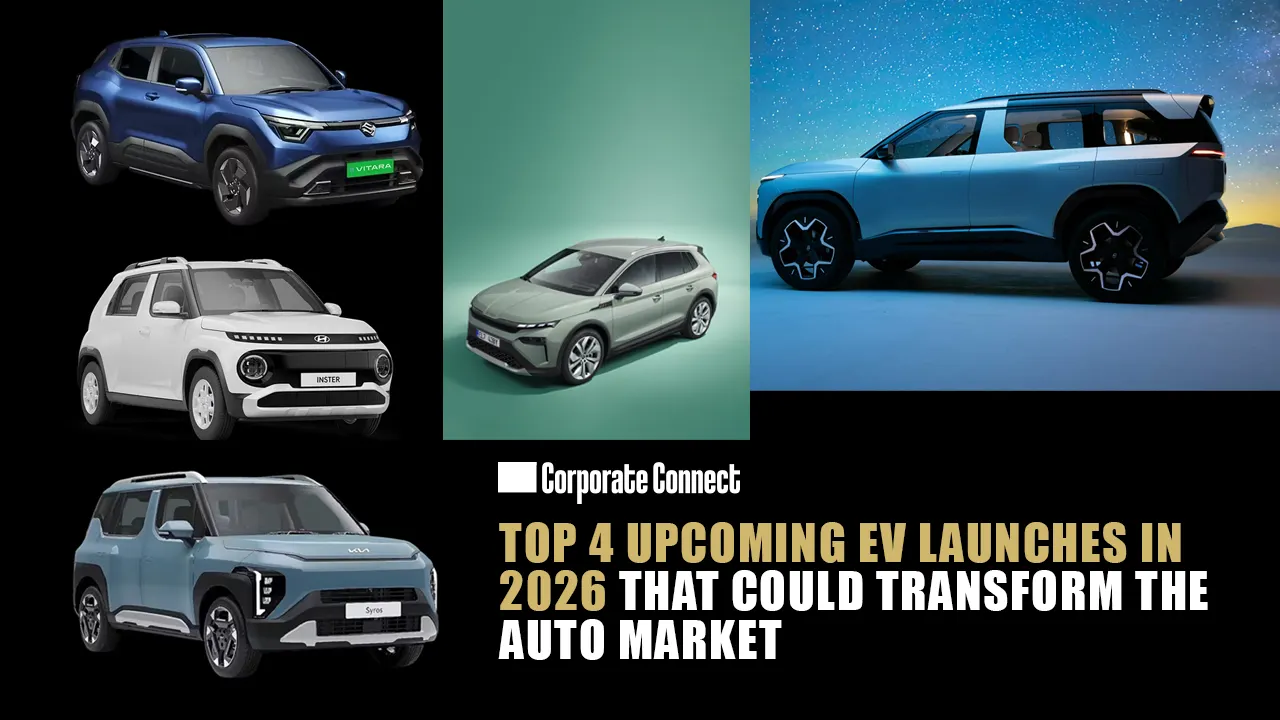
In 2026, the Indian EV market is expected to grow dramatically as manufacturers release a range of entry-level, mass-market, and high-end electric SUVs. As EV usage increases, it is evident that higher range, adaptable platforms, and feature-rich products are the main priorities.
- Maruti e Vitara: up to 543km range, dual battery options
- Tata Sierra EV: 450-500km range, premium positioning
- Kia Syros EV: compact, mass-market electric SUV
- Hyundai Inster EV: 300km+ range, entry-level focus
- Škoda Elroq: up to 570km WLTP range, AWD and RWD options
Four major EVs are anticipated in 2026.
Tata Sierra EV

An historic Tata nameplate is making a comeback with the Sierra EV, a high-end electric SUV. It will rank higher in Tata’s lineup than the Curvv EV when it launches in 2026. The model is anticipated to have a range of 450–500 kilometers, a variety of battery combinations, and the ability to have both rear-wheel drive and all-wheel drive. Its foundation will probably be similar to Tata’s more recent EV architecture found in future models.
The Sierra EV’s design will be updated with contemporary EV style elements, a simple interior layout, and connected tech features while maintaining its distinctive upright stance and huge glasshouse.
Kia Syros EV

Anticipated in July 2026, Kia’s Niro EV will be a high-volume product aimed at the subcompact electric SUV market. The Syros EV is anticipated to have front-wheel drive, compact dimensions, and city-focused range estimates, though exact details have not yet been made public. Its battery and motor configuration is probably going to be similar to Kia-Hyundai’s worldwide compact EV platforms.
In terms of design, it will have EV-specific upgrades like a closed grille, updated lighting, and a contemporary interior with integrated amenities. The Tata Nexon EV and other small electric SUVs will be its rivals.
Hyundai Inster EV

By late 2026, Hyundai’s Inster EV, an entry-level electric vehicle, is anticipated to go on sale in India. The Inster EV is anticipated to include battery options in the 40–50 kWh range, with a stated range of more than 300 km, based on Hyundai’s worldwide EV design.
It will mostly have an urban-appropriate front-wheel-drive configuration. The Inster EV will have a function-focused cockpit with digital displays and connected technology, and its small size will make it perfect for city driving. It is anticipated to compete with the Citroën eC3 and Tata Punch EV.
Škoda Elroq EV

The brand’s next-generation electric SUV plan is represented by Škoda’s Elroq EV, which is anticipated to launch by the end of 2026. The Elroq, which is built on a specific EV platform, will come with a variety of battery combinations, such as a 63 kWh (59 kWh usable) and 82 kWh (77 kWh usable) pack. It delivers a WLTP range of up to approximately 570 km.
Rear-wheel-drive models have power outputs of 150kW (204 PS) to 210kW (286 PS), while a dual-motor AWD vRS version may generate up to 340 PS.
With its closed-off “Tech-Deck Face,” split LED lighting, and aerodynamic surfaces, the Elroq debuts Škoda’s Modern Solid design philosophy. It has a computerized cockpit, sophisticated driver aid technologies, and a 13-inch touchscreen inside.
Additionally, DC rapid charging is supported; depending on battery capacity, a 10-80 percent charge takes about 24-28 minutes. Wider segmentation and adaptable electric platforms are evident in the 2026 EV portfolio.
As Tata keeps growing its line of high-end EVs, Maruti Suzuki’s arrival is anticipated to spur widespread adoption. Hyundai and Kia will bolster the compact EV market, while Škoda contributes worldwide EV architecture. As a result, the EV industry has grown and become more competitive, with a greater focus on usability, range, and technological integration.