
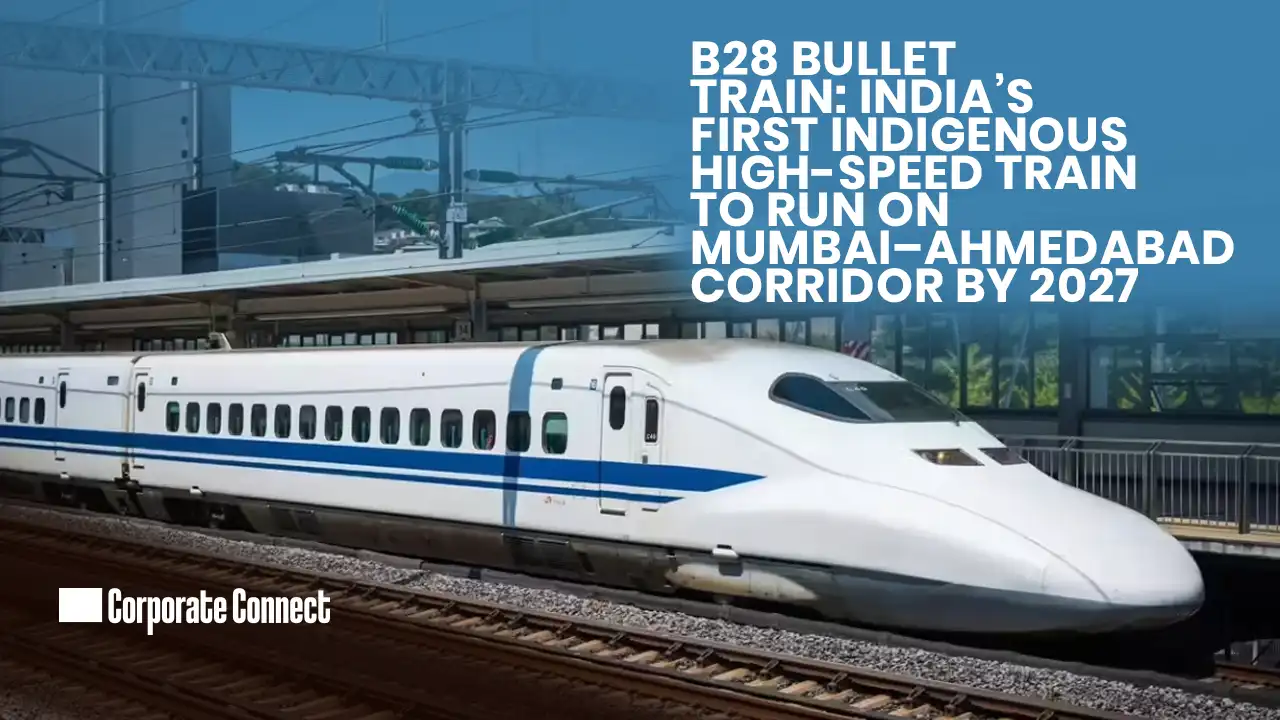
The Railways have decided to operate the domestically built B28 trainset on the first operational length between Surat and Vapi, marking the debut of India’s first homegrown bullet train on the Mumbai–Ahmedabad high-speed rail track.
The Parliamentary Standing Committee on Railways’ report, which was presented in both Houses of Parliament on Tuesday, disclosed the decision. The Railway Ministry told the panel that using the trainset being constructed by BEML, operations on the 97-km Surat–Vapi portion of the ambitious bullet train project are scheduled to start in August 2027.
The Mumbai–Ahmedabad High-Speed Rail (MAHSR) project combines cutting-edge technology and international cooperation, especially with Japan, the ministry informed the committee in response to questions over the project’s timeframe.The bullet train project is an extremely complicated and technologically demanding undertaking. Technology transfer and procurement/supply from Japan and other nations are part of the initiative. Since Japan is currently developing the E10 series of Shinkansen, comprehensive information about it is not currently accessible. However, the ministry stated that a decision has been made to begin the operation with a B28 (Bharat-built bullet trainset).
According to the report, BEML is now producing the B28 trainset, which is a major step in India’s efforts to domesticate high-speed rail technology.
The panel was also told by the ministry about the advancement of work on crucial systems. It stated that ETCS Level 2-based alternative signaling system tenders have been granted and that installation has started.
The ministry stated that the start of operations will depend on the completion of several components, including civil works, track laying, electrical systems, signalling and telecommunications, and supply of trainsets, but it declined to provide a definitive timeline for the entire corridor.Nonetheless, plans are in place to begin operations using the B28 (Bharat-made bullet, 280 kmph) for Surat-Vapi (97 km) in August 2027, according to the report.
The committee also asked for information regarding the project’s cost increase. The ministry clarified that the first cost estimate of Rs 97,636 crore, which was created in December 2015, was predicated on the feasibility report and expected that construction would mostly involve embankments and viaducts.
Costs have increased since then due to a number of other variables. The ministry stated that taxes and cess (Rs 29,330 crore), utility shifting (Rs 2,625 crore), station approach development (Rs 2,195 crore), power sourcing arrangements (Rs 1,250 crore), indigenous trains and ETCS signalling system (Rs 16,500 crore), ticketing (Rs 283 crore), and statutory charges related to forest clearances (Rs 400 crore) were not included in the initial estimate.
Additionally, since the project was approved in 2015, the increase in economic inputs of production (inflation and price increases) is Rs 19,084 crore. The cost of land, relocation, and rehabilitation has increased to Rs 16,695 crore due to the significant rise in land prices, especially in urban regions like Mumbai. The Mumbai Ahmedabad High Speed Rail Line project’s updated cost estimate is being approved, according to the ministry.
India’s premier bullet train project, the Mumbai–Ahmedabad High-Speed Rail project, is anticipated to revolutionize intercity travel along the crowded western corridor by eventually connecting the two financial centers with trains that can reach speeds of more than 300 kmph. When the Surat–Vapi leg opens for business, it will be the first indication of India’s much anticipated bullet train era. (With TOI’s input)
FAQ: India-Made B28 Bullet Train on Mumbai–Ahmedabad Corridor
Q1. What is the B28 bullet train?
The B28 is India’s first indigenously built high-speed bullet trainset, currently being manufactured by BEML. It represents a major step toward developing domestic high-speed rail technology in India.
Q2. When will the B28 bullet train start operations?
The Railway Ministry has indicated that the B28 trainset is expected to begin operations in August 2027, initially running on the Surat–Vapi section of the high-speed corridor.
Q3. Which route will the B28 bullet train operate on first?
The first operational stretch will be the 97-km Surat–Vapi section of the Mumbai–Ahmedabad High-Speed Rail corridor.
Q4. What is the expected speed of the B28 bullet train?
The B28 trainset is designed to operate at speeds of up to 280 km/h, making it one of the fastest trains ever developed in India.
Q5. Is the bullet train project supported by international partners?
Yes. The Mumbai–Ahmedabad High-Speed Rail project involves significant technology collaboration with Japan, including expertise from the Shinkansen network.
Q6. Why was the B28 train chosen instead of Japanese models?
While Japan is developing the new Shinkansen E10 series, complete details are still unavailable. Therefore, India has decided to begin initial operations with the domestically built B28 trainset.
Q7. What advanced technologies will be used on the corridor?
The corridor will feature an ETCS Level 2–based signalling system, advanced telecommunications, modern electrical infrastructure, and dedicated high-speed tracks to ensure safety and efficiency.
Q8. What is the current estimated cost of the bullet train project?
The project was initially estimated at ₹97,636 crore in 2015, but costs have increased due to inflation, land acquisition, taxes, technology upgrades, and additional infrastructure requirements. The government is currently working on an updated cost estimate.
Q9. Why has the project cost increased over time?
Major reasons include:
-
Higher land acquisition and rehabilitation costs
-
Taxes and statutory charges
-
Infrastructure upgrades such as ETCS signalling and indigenous trainsets
-
Rising construction and material costs due to inflation
Q10. Why is the Mumbai–Ahmedabad bullet train project important for India?
The Mumbai–Ahmedabad High-Speed Rail corridor is India’s flagship bullet train initiative. Once fully operational, it is expected to transform intercity travel, connecting two major economic hubs with trains capable of speeds exceeding 300 km/h and significantly reducing travel time.