

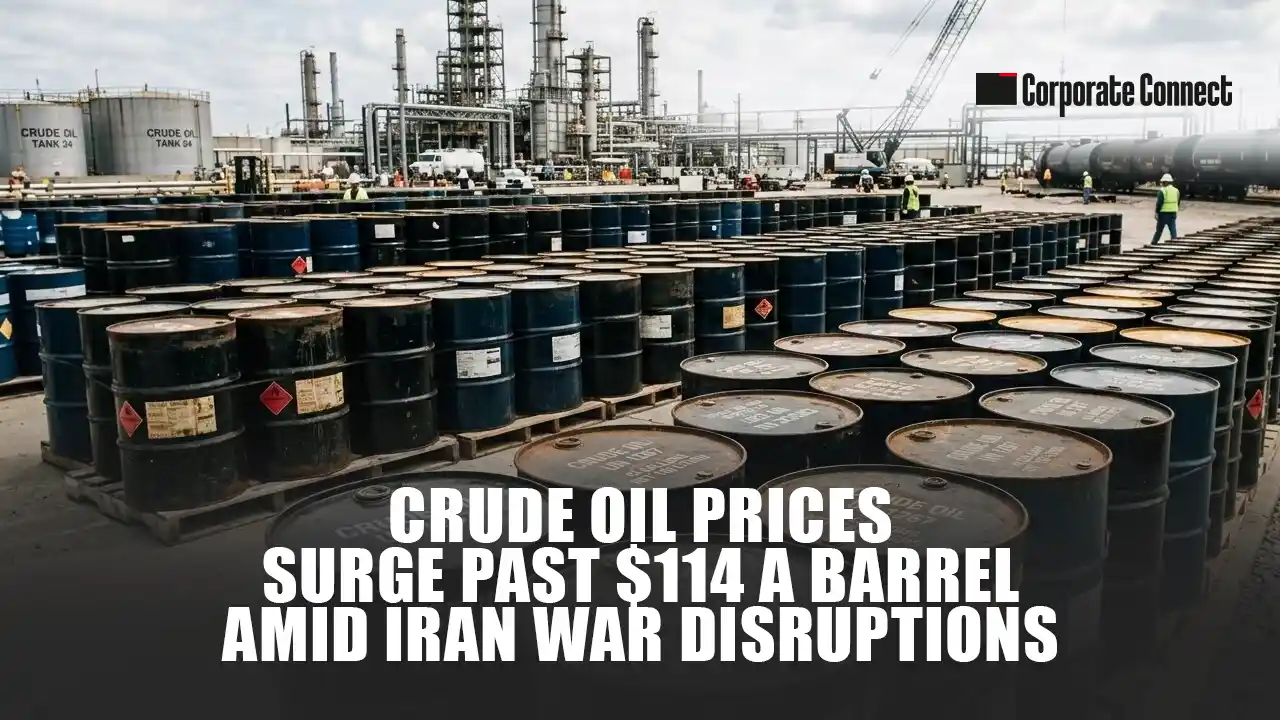
Oil Prices Surge Past $114 Amid Escalating Iran War
The price of U.S. oil futures last surpassed $100 per barrel on June 30, 2022, when it hit $105.76. For Brent, the price reached $104 per barrel on July 29, 2022.
On Monday, March 9, 2026, oil prices surpassed $114 per barrel for the first time since 2022 as the Iran War worsened, endangering West Asian shipping and production.
After the resumption of trading on the Chicago Mercantile Exchange, the price of a barrel of Brent oil, the worldwide benchmark, shot up to $114. That was a 23% increase from its closing price of $92.69 on Friday, March 6.
The light, sweet crude oil made in the US, West Texas Intermediate, was likewise selling for around $114 per barrel. That is a 25% increase over its Friday, March 6, close of $90.90.
Middle East Conflict Disrupts Oil Supply and Shipping
Early on Monday, March 9, the war’s toll on civilian targets increased as oil storage in Tehran smoldered after Israeli attacks overnight, and Bahrain accused Iran of attacking a desalination plant vital for drinking water supplies.
The price rises came after last week’s 36% surge in U.S. oil and 28% increase in Brent crude. As the conflict, which is already in its second week, has engulfed nations and locations vital to the production and transportation of gas and oil from the Persian Gulf, oil prices have skyrocketed.
According to independent research company Rystad Energy, the Strait of Hormuz normally handles roughly 15 million barrels of crude oil per day, or 20% of the world’s total oil. Tankers that transport oil and gas from Saudi Arabia, Kuwait, Iraq, Qatar, Bahrain, the United Arab Emirates, and Iran have almost ceased passing through the strait, which is bordered to the north by Iran, due to the potential of Iranian missile and drone assaults.
As storage tanks fill, Iraq, Kuwait, and the United Arab Emirates have restricted their oil output since they can no longer export petroleum. Since the beginning of the conflict, Iran, Israel, and the US have also attacked oil and gas facilities, exacerbating supply issues.
Impact on Global Economy and Energy Markets
The most recent instance of U.S. crude futures trading above $100 per barrel occurred on June 30, 2022, at a price of $105.76. The price of a barrel of Brent reached $104 on July 29, 2022.
Since Israel and the United States invaded Iran on March 1, oil prices have surged globally, shaking financial markets and raising concerns that rising energy costs could drive inflation and reduce spending by American consumers, the country’s primary economic engine.
According to the AAA Motor Club, a gallon of standard gasoline in the United States increased to $3.45 on Sunday, March 8, which is almost 47 cents higher than it was a week ago. The price of diesel was rising by around 83 cents every week to nearly $4.6 per gallon.
Energy Secretary Predicts Possible Price Stabilization
Speaking on CNN’s “State of the Union,” Energy Secretary Chris Wright predicted that gas prices in the United States will return to less than $3 per gallon “before too long.”
“Look, you never know exactly the time frame of this, but, in the worst case, this is a weeks, this is not a months thing,” said Mr. Wright.
Some investigators and investors believe that the world economy may not be able to sustain oil prices above $100 per barrel.
Attacks on Oil Infrastructure Raise Supply Concerns
The Iranian authorities, four individuals were murdered early on Sunday, March 8, when Israel attacked oil storage in Tehran and a petroleum-transfer port. The Israeli military said that Iran’s military was using the facilities to get fuel for missile launches. Iran’s parliament speaker, Mohammad Bagher Qalibaf, cautioned that the war’s effects on the country’s oil sector will worsen.
Iran sells about 1.6 million (16 lakh) barrels of oil per day, largely to China. If Iran’s supplies are affected, China could have to find another source, which might raise energy costs.
Natural Gas Prices Also Rise
Although it hasn’t increased as much as oil, the cost of natural gas has also increased throughout the conflict. Late on Sunday, March 8, it was selling for around $3.33 per 1,000 cubic feet. After increasing by around 11% last week, that is 4.6% more than its closing price of $3.19 on Friday, March 6.
FAQs
1. Why did oil prices rise above $114 per barrel?
Oil prices surged past $114 due to escalating tensions in the Iran war, which disrupted oil production and shipping routes in the Middle East, especially through the Strait of Hormuz.
2. When was the last time oil prices crossed $100 per barrel?
U.S. crude oil futures last crossed $100 per barrel on June 30, 2022, reaching $105.76, while Brent crude hit around $104 per barrel on July 29, 2022.
3. How does the Strait of Hormuz affect global oil supply?
The Strait of Hormuz is one of the world’s most important oil transit routes, handling nearly 20% of global crude oil shipments daily. Any disruption there can significantly impact global energy markets.
4. Which countries are most affected by the disruption in oil exports?
Countries like Saudi Arabia, Kuwait, Iraq, Qatar, Bahrain, the United Arab Emirates, and Iran are heavily affected because their oil exports typically pass through the Strait of Hormuz.
5. How could rising oil prices impact the global economy?
Higher oil prices can increase fuel and transportation costs, raise inflation, and reduce consumer spending, which may slow economic growth worldwide.
6. Are gasoline prices expected to increase further?
Gasoline prices have already risen in several regions due to the oil surge, but officials suggest prices could stabilize if geopolitical tensions ease and supply routes reopen.
7. Has the conflict affected natural gas prices as well?
Yes, natural gas prices have also increased during the conflict, though the rise has been smaller compared to the surge in crude oil prices.