

-By Jaya Pathak
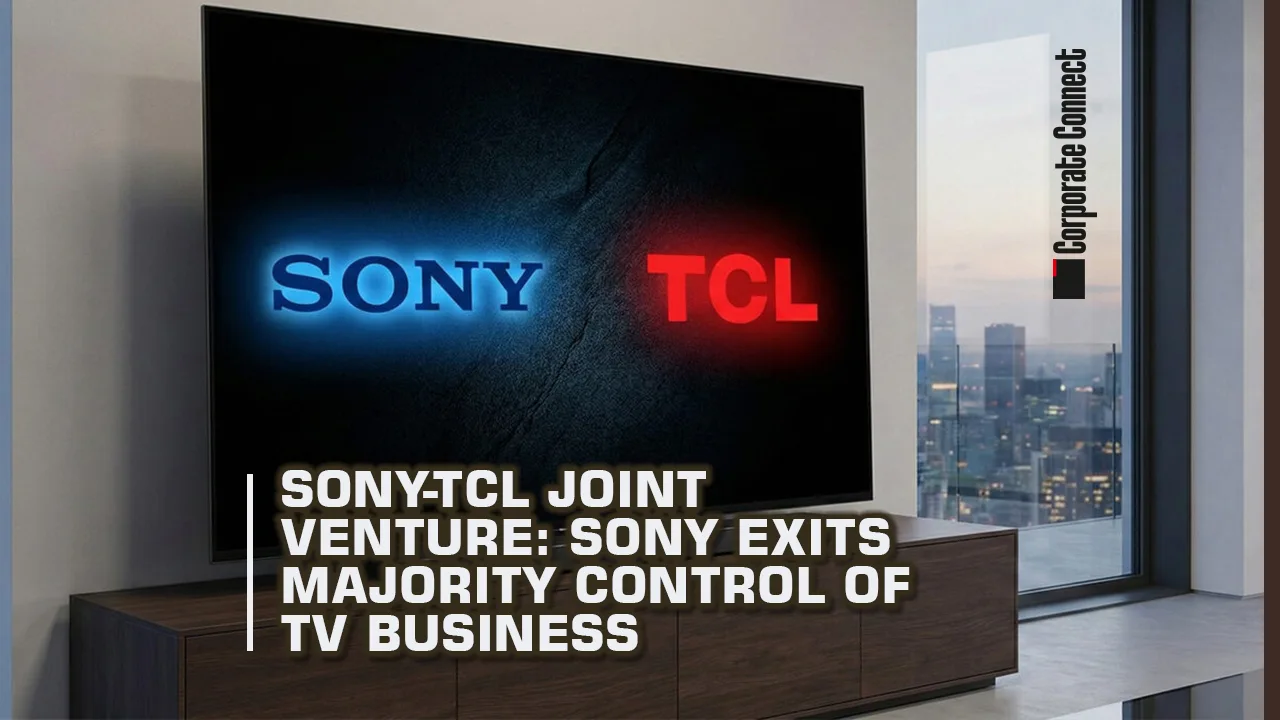
The fact that Sony has decided to put its television and home-audio hardware business into a new joint venture with TCL being the 51 percent majority partner and Sony the 49 percent minority partner is not a surrender in the consumer electronics business; it is a repositioning of what Sony wants to own. The framework denotes a premeditated change: Sony retains the high-value brand, fundamental picture/audio technologies, and the marketing pledge, but gives the day-to-day operating authority the manufacturing scale grind and all to a partner made to it.
The bargain
The memorandum of understanding outlines a worldwide joint venture that will be taking the home entertainment business of Sony; the whole chain of product development and designing to manufacturing, sales, logistics, and customer care. TCL will have divided 51% of the shares, which will result in them having majority control at the expense of 49 to Sony.
The companies have stated that they focus on shifting to definitive agreements until the end of March 2026, pending regulatory approvals, operations are planned to start in April 2027. The joint venture products will be called Sony and BRAVIA with the consumer facing brand being retained despite the change in the operation authority.
Why should Sony give up the steering wheel:
TV production has turned into a business with cost curves that are rough. Brand equity in this context, will not create the shields necessary to protect the margins in case your supply chain is grimier, your panel buying is less formidable, and your manufacturing presence is less than your competitors which have 10 years of vertical leverage. According to the announcement of the partnership by Sony, it will be marketed as a merger between the picture/audio technology of Sony and its brand value and the display technology of TCL and its industrial presence, and the overall cost-effectiveness of the end product.
Those phrasing matters. What Sony is actually doing is to focus on what has traditionally been its strength imaging expertise, processing, industrial design savvy, and brand credibility and outsource the components of the value chain whose scale advantage defines profitability. The same rationale has redefined other mature hardware groups: The control point is no longer a matter of assembling lines but one of software, processing, user experience and brand based price control.
Consider the alternative that Sony is escaping which is to be the majority-holder would be to continue being the main shock-absorber when it comes to the procurement shocks, mistaken inventory reads, factory use and the unrelenting compression of the mid-range TV market price every year. JV structure limits that exposure but the minority participation and re-monetization of the brand by Sony.
Why TCL would desire the Sony brand on its case
TCL does not require Sony to manufacture televisions, they desire Sony to market them and sell them at a profit in the international market with a reputation that opens doors in areas where trust and calibration tradition remains the issue at hand. It is anticipated that the JV will transfer the brand value and operational expertise of Sony and scale benefits as well as vertical supply chain strength of TCL.
It is also a market-access play. The channels that Sony has longstanding relations include channels in which the premium positioning and post-sales expectations may not be negotiated. The volume could be secured through the manufacturing scale of TCL, but the brand of Sony could secure the wallet share among the customers who do not shop based on specification sheet only- film lovers, gamers and households that do not buy on the basis of perceived reliability.
The strategy gamble
The 51-49 split is not the most significant aspect of this deal, but it is the separation of identity and execution. It is likely that Sony will maintain the Sony and BRAVIA branding on the products, but the governance and operational control will be more autocratic to the TCL that will typically involve day-to-day operations of development, manufacture, logistics, sales, and support.
If that sounds risky, it is. Having a premium brand is a promise and promises are weak when the company offering the promises no longer dictates the factory pace of operation, component replacement or experience of service. Even minor flaws, such as inconsistent panel uniformity, irregular firmware release cycles, lumpy warranty performance, and the like can tarnish a decades-long reputation. The JV thus compels Sony to go outstanding in doing what most brand-based firms would underestimate at the expense of commanding quality and experience level by both controlling a contractual instead of command directives.
Boardspeak tells us that Sony is a trading operations control with strategic focus. It is also exchanging first-line power with influence, a system that can only be made functional when the model of government is equipped with teeth: specific quality measures, the right to veto important decisions, audit procedures and intellectual paths that are expeditious rather than slow as social media disclose.
What will become of BRAVIA customers and the high-end market?
Sony and TCL have indicated that the products of the new firm will be bearing the Sony and the BRAVIA brands. Such continuity is supposed to comfort their customers and the concern is whether BRAVIA is going to be a white layer brand or it is going to be a true engineering philosophy.
The future is two-fold:
Competitively, BRAVIA is priced cheaper and their differentiators, such as Sony processing and audio experience combined with TCL cost structure would mean that the premium segment would not be as expensive as such, which the commentary predicts the JV may enhance price competitiveness.
BRAVIA is a brand used on a line of products optimised in terms of both cost and volume, and premium differentiation watered down with time so far as they are operated with KPIs that focus on throughput and margin stability rather than obsessive calibration efforts.
The following 18 months will be of importance since concurrence agreements are yet to be made, neither operations nor services are anticipated to start before April of 2027. The impacts of brands will be more determined by the facts of a contract than by the intentions behind press-release intent: which approval you get on which panel selection, which firmware roadmap, ownership of service quality, liability when a quality failure creates an effect on the scale of a recall.
The Portfolio logic of Sony
In terms of strategy, this JV is in line with a global trend: firms with valuable IP and brand equities are gradually shedding lower-margin, capital-intensive manufacturing where it is hard to protect differentiation. Reports on the deal underscored the changing position of Sony to shed off low-margin consumer electronics and focus on high-return IP-centered components.
The JV does not put an end to the involvement of Sony in TVs, it only alters the economic posture. Sony is less of a manufacturant than an operator as it is less of a technology and brand quality custodian within a common industrial base.
FAQs
1) Is Sony selling its TV business in whole?
No, TCL will have 51 percent, and Sony will have 49 percent.
2) Sony-branded BRAVIA TVs still in existence?
Yes, the company products will be bearing the name Sony and BRAVIA.
3) Who operates day to day activities under the proposed structure?
TCL with 51 percent ownership would dominate the governance and day to day operations in development, production, distribution, sales and after sales support of the Sony brand of television and home audio equipment.
4) What is the start of operation of the joint venture?
The firms have also indicated that they would agree upon binding arrangements by the expiry of March 2026 (providing that no functioning approval is unsuccessful), and a startup is projected to start in April 2027.
5) What contributions do the two parties make to the partnership?
Sony has aligned its contribution in the form of picture/audio technology, brand worth and operational experience, whereas TCL has contributions in the form of display technology, scale internationally, industrial presence and end to end cost effectiveness through vertical supply chain dominance.